





The Al Majaz balcony goes unusable in late April
A resident in one of the Al Majaz 2 corniche-front towers told us last May that her family had stopped eating dinner outside in mid-April and didn't go back out until November. The mosquito pressure from the lagoon was that constant. By 7pm on a still evening, you'd lose a glass of water to the surface drowning of insects that had landed in it.
Sharjah's Al Majaz lagoon is a beautiful piece of urban planning, and it's also a 2km perimeter of brackish, slow-moving water. That combination — saline, vegetated, periodically warm — is excellent habitat for two genera that matter for residential pest control: Aedes (the daytime biter, the dengue vector) and Culex (the dusk-and-dawn biter, the West Nile vector). Add the year-round AC condensate trays on every balcony around the lagoon and you have a closed-loop breeding cycle that doesn't break for cold weather, because Sharjah doesn't really have cold weather.
So when residents in Al Majaz 1, Al Majaz 2, Al Majaz 3, and the Al Qasba canal-side blocks ask why their building has more mosquitoes than friends in Al Khan or Al Taawun — the answer is the lagoon, and it's not going away. What you can do is cut the in-building breeding cycle and reduce the pressure to manageable.
Aedes vs Culex — different ecology, different control
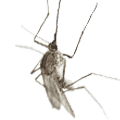
The two mosquito genera responsible for almost all bite complaints in Al Majaz behave differently and need different interventions.
Aedes aegypti and Aedes albopictus breed in small artificial containers — your AC condensate tray, the saucer under a balcony plant pot, the unused bucket on the laundry shelf, the irrigation drip cup. They bite during the day. They're the dengue and chikungunya vectors. They are container-driven; eliminate the container, eliminate the population. Lagoon water doesn't directly produce Aedes, but lagoon-edge planting and irrigation does.
Culex pipiens complex breeds in larger semi-permanent water — the lagoon shallows, vegetated drainage swales, neglected fountain features. They bite at dusk and into the night. They're the West Nile vector. They are habitat-driven; the lagoon itself is the source. You cannot eliminate the source, but you can break the larval-to-adult cycle with biological larvicide and you can reduce adult pressure with targeted ULV.
For an Al Majaz balcony being chewed at sunset, the dominant species is almost certainly Culex from the lagoon. For a balcony bite at 11am, almost certainly Aedes from a container source on or near the property.
What's actually causing your bedroom mosquitoes
A common pattern in corniche-front Al Majaz flats: residents close the balcony door at sunset to keep mosquitoes out, and still wake up to bites. The path is almost always the AC drainpipe.
Every split AC unit produces condensate water that drains through a thin pipe out of the apartment. The pipe terminates either on the balcony, in a chase shaft, or down the side of the tower. Mosquitoes — Aedes in particular — readily lay eggs in the standing water inside the drainpipe collar where it exits the wall. Larvae develop inside the pipe. Adults emerge inside the pipe and walk straight up the same conduit into your room.
Sealing the drainpipe collar with mesh-faced silicone fixes most bedroom mosquito complaints in Al Majaz buildings. It's a 15-minute job per unit.
The other internal breeding source we find regularly: water in the saucers under balcony plants. Aedes lays eggs in volumes as small as a tablespoon. A single forgotten saucer with a film of water can produce 60–100 mosquitoes per week.
The Sharjah Municipality role
Sharjah Municipality's pest section runs lagoon-water larvicide treatments on a published schedule and intermittently fogs municipal-edge greenery during peak season. This handles the Culex baseline. What it doesn't handle is the in-building breeding cycle on AC condensate, balcony saucers, and irrigation manifold pooling — that's the resident or building-level scope.
A building-wide PestSwift programme for an Al Majaz tower typically pairs with the municipal schedule rather than duplicating it. We don't fog the lagoon edge — that's Sharjah Municipality territory. We attack the in-building sources the city programme doesn't reach.
What a building-level treatment looks like
For a typical 200-unit Al Majaz tower with chronic mosquito complaints from corniche-facing flats, a 90-day programme runs roughly like this:
- Site survey of every accessible AC drainpipe outlet on the lagoon-facing elevation, every balcony planter water source, every podium-level fountain or feature.
- BTI larvicide briquettes (Bacillus thuringiensis israelensis) placed in every standing-water source on the property — irrigation manifolds, fountain reservoirs, podium drainage swales, planter saucers. BTI is biological, kills only mosquito and blackfly larvae, safe for fish, birds, and humans.
- AC drainpipe collar mesh-seal on every accessible exterior outlet. We use a 0.4mm stainless mesh + silicone collar. Stops adult emergence into the building envelope without restricting condensate flow.
- Targeted ULV (ultra-low volume fogging) of podium planting on a 21-day cycle during peak season (May to October). We use deltamethrin or bifenthrin at the lowest effective dose, applied at dawn or dusk to limit non-target impact.
- Resident-level guidance distributed by the OA: empty saucers weekly, check the laundry-room floor drain, don't leave bucket water standing.
A 200-unit programme averages AED 18,000–28,000 for a 90-day peak-season cycle. Per-unit basis: AED 90–140 for an entire summer of treatment, which is dramatically cheaper than ad-hoc unit-by-unit fogging when residents complain.
Single-flat treatment for tenants
If your building hasn't booked a programme, a single-flat treatment in Al Majaz 1/2/3 runs AED 250–400 and includes:
- Internal balcony and AC drainpipe inspection
- BTI placement in any standing water sources on the unit
- Mesh-seal of the AC drainpipe collar
- Residual application around balcony door frames and window screens
- Optional balcony screen installation referral if your unit doesn't have one
This won't eliminate the lagoon as a pressure source — nothing will — but it cuts the in-building breeding cycle and typically drops bite frequency by 60–80% based on follow-up complaints from clients we've treated in Cluster A and Cluster B of Al Majaz 2.
Dengue risk in Sharjah — what's the actual situation
UAE health authorities have managed dengue carefully and reported sporadic local cases over the past decade, almost always traced to imported infection. The vector Aedes aegypti is present in the country, including Sharjah, and was the subject of intensified municipal control after notable outbreaks elsewhere in the Gulf.
For Al Majaz residents, the practical takeaway is that the Aedes you encounter on your balcony is theoretically capable of transmitting dengue if it bit an infected person first. The actual risk in any given year remains low, but it's not zero, which is why the BTI larvicide layer matters more than its small cost suggests.
What to do this week if your balcony is unusable
- Walk the unit and remove every container of standing water — plant saucers, the bucket on the laundry balcony, the empty drink can on the side table.
- Check the AC drainpipe outlet on the exterior of your wall. If you can see standing water inside the pipe lip, that's a breeding site. We'll mesh-seal it for AED 50–100 per unit during a treatment visit.
- Don't bother with citronella candles. They're decorative. The active dose at 1m is below the level that meaningfully repels Aedes or Culex.
- Get a unit treatment booked, or push your OA to scope a building programme. The latter is dramatically more cost-effective if you have neighbours also complaining.
Book a Sharjah mosquito treatment or read about our apartment pest control service. For mosquito biology and species detail, see our mosquito pest page. For building-access logistics in Al Majaz, see our Al Majaz area page.
Frequently asked questions
Are Al Majaz lagoon mosquitoes dangerous?
The dominant Culex population from the lagoon can theoretically vector West Nile virus, though documented local cases in Sharjah have been very rare. The Aedes populations breeding on AC condensate and balcony containers can theoretically vector dengue and chikungunya — UAE health authorities have managed sporadic imported cases but local transmission has been kept to a minimum. The bite nuisance is the immediate problem; the disease risk is low but is the reason BTI larvicide and AC drainpipe sealing are worth doing.
Why are mosquitoes worse in Al Majaz than in other parts of Sharjah?
The lagoon. Brackish, vegetated, slow-moving water 2km in perimeter, located directly upwind of corniche-fronting residential towers. Sharjah Municipality treats it on schedule but cannot eliminate it as a habitat. Al Majaz residents see roughly 3–5x the dusk Culex pressure compared to inland Sharjah neighbourhoods like Al Nahda or Muweilah.
Does fogging actually kill mosquitoes long-term?
Adult fogging gives 24–72 hours of suppression. It does not affect larvae or eggs. Fogging alone is a treadmill — fog, mosquitoes return, fog again. The leverage move is breaking the larval cycle with BTI in the breeding sources. ULV fogging is the supplement, not the solution. Companies that quote "monthly fogging" without addressing breeding sources are selling you the maintenance dose without the cure.
What kills mosquito larvae in standing water safely?
BTI (Bacillus thuringiensis israelensis) — biological, kills only mosquito and blackfly larvae, no effect on fish, birds, mammals, or beneficial insects. We use BTI briquettes that release for 30–90 days per dose. A 200g briquette in a fountain reservoir or irrigation manifold is the right tool. For balcony plant saucers, a smaller granular product applied weekly works fine.
Tags
Written by
Dr. Karim El-Sayed, Lead Entomologist
PestSwift technicians and entomologists publish field-tested pest control guidance for UAE homes and businesses.