
Spraying ants in an Al Reem Island flat usually makes it worse
Pharaoh ants don't behave like the ants you grew up with. Spray a colony of Monomorpium pharaonis — and most of the tiny yellow-brown ants you see on Al Reem Island kitchen counters are pharaoh ants — and the colony doesn't die. It splits.
This phenomenon is called budding. Survivor workers and a stressed queen migrate to a new harborage, found a satellite colony, and continue. A unit that had ants in one trail behind the kettle now has ants in three locations. The original colony in the wall void may stay active. The new colonies are smaller, less visible, harder to find, and — crucially — they keep producing reproductive females.
This is why a Marina Square 2-BR resident who sprayed every ant trail in the kitchen for six weeks finally called us reporting "ants are now in the bathroom and the laundry too." That wasn't bad luck. That was an invisible split caused by surface spraying.
The Tadweer 2024 stats showed Abu Dhabi residents filed over 16,000 ant complaints in a single year. Al Reem Island, with its dense tower stock, garden landscaping, and ocean-mediated mild winter, is one of the most ant-active sub-markets in the emirate.
Pharaoh vs ghost vs odorous house ant — they're not all the same
The three ant species we see most in Al Reem Island towers respond very differently to treatment. Identifying which species you have changes the protocol.
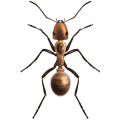
- Pharaoh ant (Monomorpium pharaonis): tiny (1.5–2mm), yellow to light brown, walks in slow trails. Multi-queen colonies. Buds when stressed. The standard Al Reem tower ant. Treatment: protein/sugar gel-bait rotation, NEVER spray.
- Ghost ant (Tapinoma melanocephalum): even smaller (1.3–1.5mm), pale legs and abdomen with a darker head. Runs erratically rather than trailing. Loves moisture — bathroom and AC drainpipe areas. Multi-queen, also buds. Treatment: sweet gel-bait + moisture source elimination.
- Odorous house ant (Tapinoma sessile): slightly larger (3mm), dark brown, smells like rotten coconut when crushed. Less common in towers, more in landscaped ground-floor flats. Single-queen colonies, doesn't bud as aggressively. Some response to perimeter residual is fine.
The ant ID matters because gel-bait formulations come in two main flavours — protein-based (the right call when colonies are nursing brood) and carbohydrate-based (right when colonies are not nursing brood). Pharaoh and ghost ants in Al Reem typically need a rotation, starting with sugar-water-based bait for 7 days, switching to protein bait for 7 days, repeating until trails dry up.
Why Al Reem towers are an ant highway
Three architectural facts about Marina Square, Sun & Sky Tower, Sky Tower, and the Gate cluster make ant pressure higher than typical Abu Dhabi villas:
- Terrace planters and shared landscaping. The podium-level greenery on Al Reem developments waters daily through irrigation drip lines. The moist soil supports ant colonies year-round, and the irrigation manifold seals are imperfect.
- AC condensate routing. Most Al Reem flats route AC condensate through a chase pipe that runs through wall voids before exiting. Ghost ants follow that moisture from the exterior into bathroom walls and laundry rooms.
- Tower stack interconnection. The same shared service shafts that carry German cockroaches between JLT kitchens carry pharaoh ants between Al Reem flats — slower than cockroaches but the principle is identical.
So a unit-level spray doesn't address the colony source. The colony source is often outside your unit altogether — in the planter on the floor below, in the AC chase between you and the corridor, in the irrigation manifold on the podium.
What the right treatment looks like
A PestSwift Al Reem ant treatment is essentially three things layered together.
Step one — identify and stop spraying. First visit, the technician identifies the species, walks the trails, marks harborage entry points (kitchen plumbing chase, bathroom AC drain collar, terrace door threshold), and removes any prior surface insecticide residue with a damp cloth on the foraging surfaces. Pharaoh and ghost ants will not accept gel-bait deposited on a freshly sprayed substrate — the area smells wrong to them.
Step two — bait deployment. Pinhead-sized gel-bait dots placed at trail crossing points, NOT in trails directly. Workers find the bait, recruit nestmates, and carry the active back to harborage. Standard actives:
- Borax-based or boric acid sugar gels (slow-acting, ideal for transfer)
- Hydramethylnon protein gels (rotation partner)
- Indoxacarb gels (newer, works on tougher pharaoh populations)
Placement matters. A typical Al Reem 2-BR gets 12–20 bait dots: kitchen, bathroom, laundry, terrace door threshold, AC drainpipe collar in each room. Bait is replenished at day 7 and day 14.
Step three — the IGR layer. Methoprene or pyriproxyfen — both insect growth regulators — applied as a fine crack-and-crevice mist into wall voids and behind kickboards. IGRs prevent worker larvae from developing into reproductive females. Without new queens, colonies cannot bud effectively. This is the step that turns a "we killed visible workers" treatment into a "we ended the colony" treatment.
A standard 2-BR Al Reem ant treatment runs AED 350–550 for the initial visit and one follow-up at day 14. Severe multi-room cases may need a second follow-up at AED 150–250.
Why supermarket bait often disappoints
The bait products on sale at Lulu and Carrefour are usually fine actives at sensible concentrations. They fail in Al Reem flats for two reasons:
- Wrong placement. Putting a bait station on the counter where you see ants gets some workers but doesn't reach the harborage. A pinhead dot of gel inside the AC drainpipe collar reaches the colony's foraging gateway.
- Wrong active for the colony state. A sugar bait deployed when pharaoh ants are nursing protein-hungry brood gets ignored. A protein bait deployed when the colony is in carbohydrate phase gets ignored. Without the species ID and trail observation, you can't know which to use.
A trained technician spends 15–20 minutes watching the trails before deploying anything. That observation drives the protocol. It's the part you can't replicate from a YouTube video.
When the source is in your neighbour's flat
Sometimes the trail leads to a wall void that's also bordered by your neighbour's bathroom or terrace planter. In that case, the colony is "yours" but lives in shared infrastructure. The honest answer is that ending the colony requires either:
- The neighbour also treating (we'll coordinate this where we can — buildings like Marina Square and Beach Towers have been receptive in our experience), OR
- Building-level intervention through the OA on the irrigation system / shared chase / podium planters
A single-unit treatment in this scenario knocks down ants for 3–6 weeks and cycles back. We tell residents this upfront so they're not surprised.
What to do this week if your kitchen is active
- Stop spraying. Aerosol insecticides cause budding and contaminate bait acceptance.
- Don't wipe trails with bleach or strong cleaners. Mild soapy water is fine. The trail pheromone matters less than the harborage location, and ants will re-trail quickly.
- Look for the entry point. Where do they emerge? Around the AC drain collar? Through the kitchen plumbing chase? The terrace threshold? Document it for the technician.
- Book an inspection. We'll species-ID, build the bait protocol, and tell you straight if the source is in your unit or in shared infrastructure.
Book an Al Reem Island ant inspection or learn more about our apartment pest control service. For broader ant biology, see our ants pest page. For Al Reem-specific access logistics and timing, see our Al Reem Island area page.
Frequently asked questions
Why do my ants come back stronger after I spray?
Pharaoh and ghost ants — the two most common Al Reem tower species — respond to insecticide stress by budding. The colony splits, the queen migrates, satellite colonies form. The ants you see two weeks later are often a more dispersed, harder-to-treat population than the one you started with. This is well-documented behaviour in Monomorpium pharaonis, not bad luck or company underperformance.
Are pharaoh ants dangerous?
Pharaoh ants are mechanical disease vectors — they walk through drains, food prep surfaces, and (in commercial settings) hospital wound dressings. In residential Al Reem flats, the practical risk is food contamination rather than disease. They don't sting or bite painfully like fire ants. They are a recognised hospital pest because of their drain-walking behaviour, which is why JCI-accredited hospitals in Abu Dhabi maintain strict ant control programmes.
How long does it take for ant baits to work?
Pharaoh ant gel-bait protocols typically show trail reduction by day 5–7 and full trail elimination by day 14–21. Ghost ants slightly faster, often noticeable reduction by day 3–5. The 14-day follow-up visit is when we re-bait, swap actives if response is partial, and apply the IGR layer.
Can I treat my flat alone if my neighbour also has ants?
You can, but expect cycling reinfestation if the source colony is in shared infrastructure (corridor planter, AC chase, OA-managed irrigation manifold). The fix is coordinated unit treatment plus building-level intervention. We've seen good cooperation from OAs in Marina Square, Beach Towers, and Sun & Sky Tower — talk to your building manager and let us write the OA-level scope.
Tags
Written by
Dr. Karim El-Sayed, Lead Entomologist
PestSwift technicians and entomologists publish field-tested pest control guidance for UAE homes and businesses.