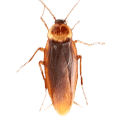



The German cockroach lives where you don't see her
The first PestSwift technician to inspect a Cluster T flat in Jumeirah Lake Towers last September pulled 38 dead and 11 live German cockroaches out of the dishwasher motor cavity. The kitchen counters were spotless. The previous company had been spraying surfaces every two weeks for four months.
Spray-on-surface fails German cockroaches almost every time in JLT, and not because of laziness. It fails because Blattella germanica doesn't live on your countertop. She lives in the dishwasher motor void, in the cabinet hinge channels, behind the fridge compressor, in the AC drainpipe collar, in the wall void where the kitchen sink trap penetrates. She comes out at night, takes a few seconds of food and water on the counter, and goes back to harborage. Surface residual catches her for the four seconds she's exposed and is gone by the time the second nymph emerges.
Then there's the JLT-specific problem: shared infrastructure between stacked kitchens.
Why JLT towers cycle infestations
JLT was built on a residential-tower template that stacks identical kitchens floor-on-floor on shared service risers. The chiller line, the kitchen waste stack, the cold water riser, and the AC condensate drain all run vertically through a wet riser shaft connecting your unit to the unit above and below.
German cockroaches travel that shaft. Reliably. We've documented populations moving four floors in two weeks through a single chiller riser in towers around Cluster J and Cluster X. So when only your apartment gets treated, three things happen:
- The local population in your kitchen takes a hit
- The riser population is unaffected
- Within 3–4 weeks, fresh cockroaches travel down the riser and recolonise
This is why JLT residents who treat once, see good results for a month, and then watch the problem come back are not imagining it. The treatment worked. The riser is the problem.
What the kitchen looks like during a real inspection
When a PestSwift technician inspects a JLT kitchen for German cockroaches, this is the actual sequence. None of it is dramatic. All of it matters.
- Pull the dishwasher. The motor cavity behind the kick plate is the single most reliable harborage point in JLT towers. Warm, moist, dark, with food residue from rinse runoff. Nine times out of ten, this is ground zero.
- Pull the fridge. The compressor coils stay warm. The condensate evaporator pan collects water. Cockroaches nest in the foam insulation around the compressor.
- Open every cabinet hinge. German cockroaches lay oothecae (egg cases, 30–40 eggs each) in the cup-hinge channel. You'll see them as small brown rice grains.
- Check the sink trap penetration. Where the drain goes through the cabinet floor, the seal is rarely tight in JLT towers. The void around it connects directly to the wet riser.
- Inspect the AC condensate drainpipe. The collar where it exits the cabinet is a classic entry route from the chase shaft.
- Check the kettle and microwave. Long-overlooked. The base of an unmoved kettle and the back of a built-in microwave are warm harborages.
A unit with an active German cockroach population shows fecal spotting (small black dots) at all of these points. A unit without active infestation shows none. The inspection takes 25–40 minutes done properly.
What treatment actually works
Source-based gel-bait, not surface spray. Specifically:
- Hydramethylnon or fipronil-based gel-bait placed in pinhead-sized dots inside the dishwasher motor cavity, the fridge compressor void, every cup hinge, the sink trap collar, and the AC drainpipe collar. We use 0.05–0.1g per placement, 8–14 placements per kitchen.
- An IGR (insect growth regulator) like hydroprene applied as a crack-and-crevice spot in voids the gel doesn't reach. IGRs don't kill adults — they prevent nymphs from moulting into reproductive adults. Combined with bait, this collapses the colony in 14–21 days.
- No surface spray on countertops. Repeated surface spraying kills foragers but pushes survivors deeper into harborage and can cause some populations to switch to non-toxic food sources, ignoring the bait. We've watched this happen in JLT clusters where another company over-sprayed before we took over.
The active ingredients we use are all on the Dubai Municipality approved list (the November 2024 update kept hydramethylnon, fipronil, and hydroprene). Cost for a standard JLT 1-BR is AED 350–500 for the first visit and one follow-up at day 14.
When the riser is the problem
When the same unit reinfests within 30 days of a clean treatment, the riser is the source. At that point, treating only your apartment is throwing money. The fix is one of three:
- Coordinate a stack treatment with the building Owners' Association. Treat 3–4 contiguous floors in the same vertical line over a two-week window. We've done this in Lake Terrace, Saba 1, and Bonnington — costs around AED 250–350 per unit when scheduled together.
- Treat the riser shaft directly. Some JLT towers allow access to the wet riser through the service room. Targeted gel-bait and IGR fogging in the shaft kills the in-transit population.
- Seal the shaft penetrations. The collar around the AC drain, the sink trap, and the cold water line in your kitchen are usually unsealed or sealed with degraded silicone. We re-seal with a rodent-grade silicone or steel wool + caulk to physically block migration.
A combined approach (stack treatment + riser fog + seal penetrations) effectively ends the cycle. We've had units in Lake View Tower stay clean 18+ months after one coordinated round.
Why surface spraying made it worse
A common pattern: tenant calls a cheap company, they spray countertops and skirting with a pyrethroid (often deltamethrin or cypermethrin). The visible adults die. The tenant feels good for two weeks. Then the population — which now has a higher proportion of bait-averse survivors and pushed-deep harborage colonies — re-emerges, and bait companies brought in afterwards have a harder time getting acceptance because the survivors associate the kitchen surface with toxin.
This is a real, documented behaviour in Blattella germanica. The first thing a good technician does on a previously sprayed unit is wait. Don't bait into a freshly sprayed substrate. Clean down counter residues, deploy the bait deep in voids, and let the colony recover its normal foraging behaviour for 7–10 days before applying the IGR.
What you should do this week if your kitchen is active
- Stop spraying anything. Including bug-bombs, citronella, peppermint oil. They scatter the population without killing it.
- Pull the dishwasher kick plate and look. If you see fecal spotting or live nymphs, you have a confirmed infestation in the riser-adjacent harborage.
- Don't bait yourself. Supermarket gel-baits are usually fipronil at 0.05% — fine active, wrong placement. The placement matters more than the chemistry, and untrained placement either misses harborage or wastes bait.
- Get an inspection. We'll tell you straight whether you have a unit-level problem (treatable in one apartment) or a riser problem (needs OA coordination).
Book a JLT cockroach inspection or read about our apartment pest control service. For broader context on cockroach biology, see our cockroach pest page. For the JLT building access logistics, see our JLT area page.
Frequently asked questions
Why do JLT kitchens get cockroaches even when they're clean?
Cleaning removes food residue from surfaces. German cockroaches in JLT survive on the food and moisture inside appliance voids, sink-trap voids, and the wet riser shaft connecting your kitchen to neighbours. Surface cleanliness has near-zero correlation with German cockroach population in JLT towers. A spotless kitchen with an active dishwasher motor cavity infestation is normal here.
Does treating one apartment fix the whole stack?
Often not. If the riser is colonised, recolonisation from above or below typically happens within 30 days. A unit-only treatment is the right move when the building has no recent cockroach history and your unit is the early case. When the building is known-active, push for a stack treatment through the OA — it's roughly the same money per unit and 5x more durable.
What chemical kills German cockroaches fastest in Dubai?
Speed is the wrong metric. The dishwasher motor cavity colony has hundreds of nymphs and oothecae you'll never see. A "fast knockdown" pyrethroid kills the foragers and leaves the breeding population intact. Hydramethylnon or fipronil gel-bait works through transfer (workers carry active back to harborage and the colony eats the corpses). It looks slower for the first 5 days; by day 14 the colony is collapsed.
How long after gel-bait do German cockroaches die?
Initial mortality starts at day 2–3, peaks around day 7–10, with full population collapse usually visible by day 14–21 depending on starting density. The follow-up visit at day 14 is when we re-assess and apply IGR if any breeding population remains.
Tags
Written by
Dr. Karim El-Sayed, Lead Entomologist
PestSwift technicians and entomologists publish field-tested pest control guidance for UAE homes and businesses.