

The first time I told a Khalifa City homeowner that the mosquito problem in his garden wasn't coming from the irrigation pond he'd been treating, he didn't believe me. The pond had visible larvae, after all. But the dengue-vector species — Aedes aegypti — won't usually breed in a pond at all. It breeds in the AC condensate tray on top of his maid's-room outdoor unit, in the standing water inside a toppled flowerpot saucer behind his shed, and in the rim of an upturned children's toy bucket.
We pulled larvae from all three on the first audit walk. The pond had Culex, which is annoying but not the dengue carrier. The Aedes was 8 metres away in three small containers, and the homeowner had been fogging the pond for a year while the actual breeding sites sat untouched.
This is the standard Abu Dhabi residential mosquito story. Knowing the difference matters now more than it used to.
What changed in the UAE dengue picture
The UAE Emirates Health Services has been running active dengue surveillance since the 2019-2020 case clusters in Sharjah and Ajman. After the April 2024 floods, ADPHC and DMT scaled the campaign sharply — nine specialised teams deployed, 1,200 entomological surveys completed across the country, 309 mosquito DNA samples processed, and 409 confirmed Aedes aegypti breeding sites eliminated.
Most of those breeding sites were on residential property. Garden flowerbeds, abandoned construction lots, AC plant rooms, irrigation valve chambers, untreated swimming pools after a renter moved out. The campaign worked because removing breeding sites is what actually controls Aedes — adult fogging is a temporary intervention.
If you live in Abu Dhabi and you're seeing more mosquitoes than two years ago, the cause isn't bad luck. It's the population aftermath of the 2024 floods, which created hundreds of thousands of cubic metres of small standing-water containers across the country and which Aedes is still working through.
Aedes vs Culex — visible differences
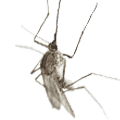
Aedes aegypti is the dengue, chikungunya, and yellow-fever vector. Black body, white "lyre" markings on the thorax, white bands on the legs. Daytime biter, especially at dawn and dusk. Indoor and outdoor.
Culex pipiens is the standard "annoyance" mosquito of UAE residential. Brown body, no dramatic markings, evening and night biter, lays in dirty standing water (ponds, blocked drains, sewage manholes). Carries West Nile virus in some regions but isn't a dengue vector.
Two reasons the distinction matters:
First, the breeding sites are different. Aedes prefers small clean-water containers — the rim of a flowerpot saucer, an unused pet water bowl, an AC condensate tray, a tarpaulin fold. Culex prefers larger dirty-water bodies. Treating the pond does nothing for the dengue vector.
Second, the daytime-biting behaviour of Aedes means you can be exposed during morning gardening even if you don't see mosquitoes at sunset. Standard "evening repellent" routines miss the actual risk window.
The eight residential breeding sites we find most often
Ranked by frequency from PestSwift's last 200 Abu Dhabi villa audits:
- AC condensate trays on outdoor units. The drip pan under a wall-mounted AC unit holds 50-200 ml of standing water at all times. Aedes loves it. Found on 86% of audits.
- Plant pot saucers. Especially under outdoor potted herbs and ornamental plants. The saucer fills from over-watering and stays wet. Found on 71%.
- Irrigation valve chambers. The buried plastic boxes housing the irrigation manifolds collect rainwater and irrigation overspill. Lid usually doesn't seal. Found on 64%.
- Children's outdoor toys. Pool noodles, bucket-and-spade sets, paddling pools left half-emptied. Found on 51%.
- Tarpaulin folds. Plot covers, BBQ covers, garden furniture covers — the fabric folds collect rainwater. Found on 47%.
- Building-site debris. Construction lots adjacent to villas leave water-holding debris. Found on 38% (only counts when adjacent to the villa being audited).
- Roof drainage outlet. Where the rooftop drainage point empties to a small ground-level catchment. Found on 31%.
- Disused outdoor showers and pool features. Decorative water features turned off but not drained, pool side-showers no longer in use. Found on 24%.
Number 1 alone — the AC condensate tray — accounts for somewhere between a quarter and a third of total residential Aedes breeding in the audits we've done.
Why fogging is whack-a-mole
Thermal fogging (the truck-mounted ULV units the municipality runs at dusk) kills adult mosquitoes flying at the moment of fog passage. Half-life of the fog cloud is 30-90 minutes depending on wind. Adult mosquitoes that emerge from the breeding sites the next morning are unaffected.
Aedes egg-to-adult cycle in UAE summer temperatures is 7-9 days. So a fogging round on Monday clears the visible adults; by the following Monday a fresh generation has emerged from the same untreated breeding sites and the population is back to baseline.
Source removal — emptying the breeding containers, treating the unsourceable ones with biological larvicide — breaks the cycle at the larval stage and gives lasting control.
The Bti larvicide we use is Bacillus thuringiensis israelensis, a bacterial spore that mosquito larvae ingest and that ruptures their gut. Specific to mosquito and blackfly larvae. No toxicity to fish, mammals, birds, or other insects. Comes in dunks (slow-release tablets) for fixed water bodies, granules for hard-to-empty wet zones, and liquid concentrate for spray application.
Larvicide treats sites that can't be physically emptied — irrigation chambers, persistent puddles, decorative ponds, building-site water collection. Source removal handles the rest.
A residential mosquito audit — what we do
A PestSwift Abu Dhabi villa mosquito audit takes 90-120 minutes:
- Walk the full external perimeter with a torch and inspection mirror.
- Open every AC plant pad and check the condensate tray.
- Lift every irrigation valve chamber lid.
- Inspect plant pots, garden furniture covers, drainage outlets, BBQ areas.
- Photograph every breeding site found.
- Empty the empty-able sites on the spot.
- Apply Bti dunks to the treat-only sites.
- Recommend physical fixes (drilled drain holes in flowerpot saucers, sealed valve chamber lids).
- Provide a written report.
Cost: AED 450-650 for a villa audit. Monthly maintenance contract (audit + larvicide refresh + adult misting where needed): AED 280-450 per month depending on villa size.
When to call ADPHC
ADPHC's free public-health pest control covers mosquitoes — they'll come to your villa for free if dengue vectors are active. Call 800555 and select Department of Health Abu Dhabi, or submit through the TAMM platform.
ADPHC will deploy a team within 24-72 hours typically. They'll do an inspection, larvicide treatment of the immediate sites, and adult fogging if needed. Free.
When private (PestSwift) is the better call: when you want a same-day visit, an ongoing contract, or documented audit reports for landlord/tenant correspondence. Both approaches are valid; many of our Abu Dhabi clients use ADPHC for the public-health response and PestSwift for the ongoing residential maintenance.
FAQ
Where do mosquitoes breed in Abu Dhabi homes?
The top three sites by frequency: AC condensate trays on outdoor units (86% of audits), plant pot saucers under potted plants (71%), and irrigation valve chambers (64%). The full top-eight list is in this post above.
Is dengue still a risk in 2026 in Abu Dhabi?
Yes. The post-2024-flood Aedes population is still elevated. EHS, ADPHC, and DMT continue active surveillance. Imported dengue cases via travel from endemic countries remain the most common source, but local transmission has been confirmed in past clusters. Personal prevention (source removal, repellent, screened windows) is meaningful.
Can fogging the garden actually stop mosquitoes?
Fogging kills the adults flying at the moment of treatment. Within 7-9 days a new adult generation emerges from any untreated breeding sites. Without source removal or larvicide, fogging is a 1-week intervention. With source removal, it's a useful supplement; without it, it's whack-a-mole.
Should I report a mosquito problem to ADPHC?
Yes if you're seeing high adult density and you suspect a public-source breeding site (construction lot, blocked municipal drain, unmaintained district pond). Call 800555. The reporting helps ADPHC's surveillance and triggers a free response. Use PestSwift villa pest control for ongoing residential coverage on your specific property.
If your Abu Dhabi villa has more mosquitoes than it should, book a PestSwift audit. We'll find every breeding site, larvicide what we can't empty, and write you a fix list. Coverage across Khalifa City, Al Raha, and surrounding districts.
Tags
Written by
Dr. Karim El-Sayed, Lead Entomologist
PestSwift technicians and entomologists publish field-tested pest control guidance for UAE homes and businesses.