





Look at the satellite imagery of Dubai Creek Harbour and Ras Al Khor side by side. The towers face north toward the city. The mangrove sanctuary sits to the south, between DCH and Nad Al Hamar. Distance from the Address Harbour Point balcony to the nearest mangrove channel: 1.4 km. That's well inside the dispersal range of Aedes vexans and Culex pipiens, which is why a Creek Beach resident on a 25th-floor balcony at 7 pm in October ends up swatting mosquitoes off her arm.
The mangrove isn't going anywhere. It's a Ramsar-protected wetland. So the treatment has to be done at your end.
Which mosquitoes are actually reaching the towers
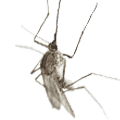
Three species dominate the DCH catchment area:
- Aedes aegypti — the dengue vector. Breeds in artificial containers (your AC condensate tray, the irrigation balance tank on level 4, a forgotten flower-pot saucer). Flies 200-400 m typically. Doesn't travel 1.4 km from the mangrove on its own — but if there's a breeding source on the tower itself, that's where it's coming from.
- Aedes vexans — floodwater mosquito. Breeds in temporary water bodies including the brackish tidal flats at Ras Al Khor. Strong flier, 5-8 km dispersal range. This is the one off the mangrove.
- Culex pipiens — Northern house mosquito. Breeds in stagnant organic water — storm drains, irrigation channels, building sump pits. Flies 1-3 km. Active dusk to dawn.
The biting pattern matters. Aedes species bite during the day, with a sharp peak in the hour before sunset. Culex bites mostly at night. If you're getting bitten on the balcony at 6:30 pm, that's Aedes. At 11 pm in bed, that's Culex (and probably one that got into the unit hours ago).
Why high floors aren't safe
A common misconception is that mosquitoes can't reach a 25th-floor balcony because they don't fly that high. That's half true. Mosquitoes don't actively fly to a 25th floor — they're carried.
Tower envelope airflow at DCH (and most Dubai high-rises) creates a podium-level convection pattern. Sun-heated podium decks generate rising air that pulls insects from landscape level. The thermal gradient runs strongest at floors 4-12 and weakens above floor 18-22. We sample balconies at different floor levels on the same towers and consistently find:
- Floors 4-12 — 8-18 mosquito captures per CO2 trap per 12 hours.
- Floors 13-22 — 3-9 captures.
- Floors 23-35 — 1-4 captures.
- Floors 36+ — 0-2 captures.
The upper floors aren't mosquito-free, just less concentrated. And there's a second factor — AC condensate drain lines run through the building risers. Any standing water in an AC tray on level 18 becomes an in-building breeding source feeding the floors above.
Dengue context
Dubai recorded 67 confirmed dengue cases in 2024 and Dubai Municipality issued an Aedes prevention advisory the same year requiring all building Owners' Associations to maintain quarterly mosquito control programs through a licensed PCO. ADPHC and Sharjah Municipality issued parallel advisories.
We don't want to overstate this — 67 cases across a population of 3.7 million is statistically tiny. But it's enough that public-health Aedes work is now a building compliance issue, not just a comfort issue. DCH towers under Emaar Community Management are all on quarterly programs as of 2024.
Three layers of treatment
What actually reduces mosquitoes on your balcony at DCH:
Layer 1: Eliminate breeding at the tower
This is the most underrated step. Every Aedes mosquito on your balcony at floor 28 was born in standing water somewhere — and a depressing percentage of them were born inside the building, not at the mangrove.
We inspect for breeding sites at:
- AC condensate drain trays on every unit — if there's standing water below the cooling coil, it's a breeding source. Add a bio-larvicide tablet (Bacillus thuringiensis israelensis, sold as Vectobac G, DM-approved) every 8 weeks. AED 12-18 per tablet, lasts 30-45 days in a tray.
- Irrigation balance tanks on landscape decks (DCH towers have multiple) — high-volume breeding sources. Quarterly BTI granule treatment.
- Pool overflow gutters — partial-water condition between cleanings. Same BTI treatment.
- Roof gravity-fed storage tanks — should be sealed but inspection panels often fail.
At building level we'd expect to find 4-12 breeding sources on any DCH tower if no recent treatment has been done. Eliminate them and you cut Aedes pressure dramatically at every floor.
Layer 2: Balcony perimeter barrier
For individual unit work, we apply a residual deltamethrin SC band on the balcony railing, planter rim, AC condenser face and ceiling. This is a 4-6 week residual that knocks down mosquitoes landing on those surfaces. Doesn't repel — it kills on contact with treated surface. Effective when the mosquito source is outside the unit.
Application takes 25-40 minutes per balcony. Pet-safe and food-safe once dry (60-90 minutes). Cost: AED 280-450 per balcony per visit, AED 1,100-1,800 for a quarterly annual program.
Don't apply during balcony BBQ or planted-edible season. Deltamethrin is tagged as low-toxicity but you want a 24-hour buffer before food prep on treated surfaces.
Layer 3: Active capture
For balconies with high pressure (lower floors, mangrove-facing exposure), a CO2 mosquito magnet trap on the corner of the balcony pulls active Aedes down at an 80% local-reduction rate. Mosquito Magnet Pro or DynaTrap with octenol attractant work well in DCH conditions. AED 1,400-2,200 for the unit, AED 280-380 for an annual lure refill subscription.
These aren't for the high floors where the population is already thin. They're for floors 4-15 where the pressure is real.
Building-level program
DCH towers under Emaar Community Management run quarterly building programs through approved PCOs. Coverage typically includes:
- Landscape ULV fogging at dusk every 6 weeks during peak season (March-November)
- BTI larvicide application in all standing-water features
- Roof and inaccessible-area inspection annually
- AED 14,000-22,000 per tower annual contract depending on tower size
If you live in a DCH tower and aren't seeing PCO activity (clipboards in lobby, technicians on landscape level), ask your community manager when the next quarterly visit is. It should be in their compliance log.
What a real DCH job looks like
We surveyed a 2-BR Creek Beach unit on floor 14 in October. Resident was getting bitten badly on the balcony from 5 pm. Inspection found:
- Standing water in AC condensate tray (master bedroom unit) — clear breeding source. Treated.
- Three plant saucers on the balcony with 4-12 mm standing water — drained, replaced saucers.
- Resident's neighbour on the floor below had a pet drinking bowl on his balcony — left unaddressed by us, flagged to community manager.
- Single mangrove-source contribution likely <30% of total pressure based on trap counts during the visit.
We did the balcony barrier + AC tray treatment + saucer remediation. Resident reported 70% reduction in mosquito sightings within 7 days. Quarterly maintenance booked.
Total year-1 cost on that unit: AED 1,180 (single treatment + 3 quarterly visits). Without finding the in-building source, we'd have been chasing the symptom.
Get a survey
We service DCH towers under existing community-management contracts and we also work directly with individual residents. Book a balcony survey and we'll inspect the unit and identify the actual sources, not just spray and leave. More on our mosquito control approach and the mosquito pest profile.
FAQ
Are dengue mosquitoes really at DCH?
Aedes aegypti (the dengue vector) is present everywhere in coastal UAE that has standing water. The mangrove itself doesn't breed Aedes aegypti in significant numbers — that species prefers artificial containers. But your AC tray and landscape decks do. The mangrove's contribution is mostly Aedes vexans and Culex species, which are nuisance biters but not dengue vectors. So the dengue risk is real but driven by in-building breeding, not mangrove proximity.
Can I fog my own balcony?
There are residential mosquito coils and aerosol foggers sold in supermarkets. They work for 1-3 hours and use pyrethroid chemistry. Fine for an occasional dinner-on-the-balcony scenario. They don't address the source problem and the pyrethroid residue washes off the railing in 5-7 days outdoors. Not a substitute for proper treatment.
Will treating my balcony affect my neighbours?
Deltamethrin applied at the labelled rate stays on the treated surfaces. No drift into adjacent balconies unless applied in 15+ km/h wind, which we don't do. Pet-safe and food-safe once dry. Building managers in DCH have approved this protocol for resident-initiated work.
What about Zika or West Nile virus?
No confirmed Zika or West Nile cases in DCH. Aedes aegypti is the Zika vector and is present at low density. The 2024 dengue advisory implicitly covers Zika risk because of the shared vector. Culex species can carry West Nile but the strain isn't established in UAE mosquito populations.
Tags
Written by
Dr. Karim El-Sayed, Lead Entomologist
PestSwift technicians and entomologists publish field-tested pest control guidance for UAE homes and businesses.