




Muweilah is mostly newer builds. Developer-installed anti-termite barriers were standard from about 2014 onward in Sharjah, which means the typical Muweilah villa is now 7-12 years past handover and right at the inflection point where the original soil-treatment chemical barrier starts losing effectiveness. We're seeing the first wave of post-warranty termite calls in the area — most of them are owners who've never had to think about termites before and don't know what's normal versus alarming.
Here's what's actually happening underground in Muweilah, and what a proper anti-termite barrier renewal costs.
The two species that matter in Sharjah
UAE has two termite genera that account for nearly all residential damage:
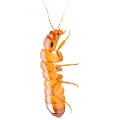
Microtermes (Microtermes mycophagus and related) is the more common of the two in inland Sharjah including Muweilah. These are subterranean termites that build mud tubes against foundation walls and feed primarily on dead wood and cellulose in soil. Damage progresses slowly but steadily; you can have an active Microtermes colony in your villa for 12-18 months before any visible signs.
Coptotermes gestroi is the more aggressive species, more common in coastal and irrigated zones (Sharjah's Khalid Lagoon side, Saadiyat in Abu Dhabi, Palm Jumeirah). It moves faster and damages structural wood within months. Less common in Muweilah but not absent — we found a Coptotermes colony in a Muweilah villa last year, traced to imported teak garden furniture that had been on a wet patio for two seasons.
Identifying which species you have changes the chemical choice. Imidacloprid-based barriers work for both. Bifenthrin works better against Microtermes. Fipronil at higher concentration is the Coptotermes go-to. A Sharjah Municipality-approved technician will confirm the species via mud-tube architecture and worker termite morphology before recommending a chemical.
Why Muweilah's soil pressure is rising
Three things make Muweilah particularly active right now:
The original developer barriers were lighter than current standards. Through 2014-2018, the standard pre-construction barrier in Sharjah was 0.05% imidacloprid at lower volumes per square metre than what's now considered correct. The chemical breaks down at roughly 0.04 kg/m³ of soil per year in UAE conditions. Many of these barriers are now below effective concentration.
Garden irrigation. Most Muweilah villas have landscaped front and back gardens with drip irrigation. The chemical barrier was installed under the original sand profile, before landscaping. Years of irrigation push moisture down through the treated layer and accelerate chemical degradation. The soil under your villa today is wetter and chemically less protected than it was at handover.
Compound block layout. Muweilah's villa rows share boundary walls. A termite colony established in your neighbour's garden has a clear path to your foundation along the shared wall. Even if your barrier is intact, you're protected only as much as the weakest neighbouring villa.
The University City proximity is another factor — heavy date palm planting along the campus perimeter introduces a constant supply of cellulose into the regional soil mass, which is termite food.
Signs your barrier is failing
Most Muweilah owners don't realise their barrier is gone until they see termites inside the villa. By that point the damage timeline is months, not years. Earlier signs to catch:
Mud tubes on foundation walls. Pencil-width earth tubes running vertically up the external concrete or render of your villa, especially behind hedges and against compound walls. These are the termite highway from soil to wood. They're easy to brush off and easy to miss — schedule a perimeter walk every six months.
Soft or hollow-sounding skirting boards. Tap your skirting along the external walls of ground-floor rooms. A papery-thin or hollow sound where it should be solid wood means termites are inside. The kitchen and the maid's room (typically against external walls) are the first to go.
Stuck door frames in one specific room. Termite damage to a door frame causes the frame to swell and stick — first noticed as a door that suddenly won't close cleanly. If it's one specific door (not a humidity-related problem affecting all doors), check the frame interior with a knife tip.
Discarded wings on window sills in March-April. Reproductive winged termites (alates) swarm in late winter / early spring in the UAE. If you find piles of identical translucent wings on window sills or near porch lights in March, you have an active colony nearby — possibly inside the building envelope.
What renewal actually involves
For a Muweilah villa post-warranty, a proper anti-termite barrier renewal is a half-day to full-day job:
Step 1 — Perimeter inspection. Walk-around with a moisture meter and a probe. Identify mud tubes, suspicious soil patterns, and any active entry vectors. Photograph everything. This is non-trivial; for a 4-5 BR Muweilah villa with garden, count on 60-90 minutes.
Step 2 — Trench around the slab perimeter. A 30 cm wide x 30 cm deep trench cut along the external footing of the villa, wherever soil meets the building. For a typical Muweilah corner villa with ~80 m of perimeter, that's ~7-8 hours of trenching by hand or 3-4 hours with a small mini-excavator.
Step 3 — Chemical injection. Imidacloprid at 0.06% concentration mixed with water at the prescribed soil volume (typically 5 litres of mixed solution per linear metre at this depth). Bifenthrin or fipronil in higher-pressure zones. Mixing happens on site under technician control; the chemical is poured into the trench and worked into the surrounding soil.
Step 4 — Sub-slab injection at known entry points. Where mud tubes were found, drill 12mm holes through the slab near the affected area, inject treated foam or solution, and seal. This is the targeted strike against any active colony.
Step 5 — Backfill and document. Refill the trench with the displaced soil. Issue a Sharjah Municipality-compliant invoice listing the active ingredient, concentration, and volumes used. Include a 1-year warranty (most companies) or 5-year warranty (a few, including ours, for full barrier renewals).
What it costs in Muweilah
For a typical Muweilah residential villa:
- 3-BR townhouse-style villa (~60 m perimeter): AED 2,500-4,200 for full barrier renewal.
- 4-BR standard villa (~80 m perimeter): AED 3,800-6,500.
- 5-BR villa with extensive garden (~110 m perimeter, multiple slab penetrations): AED 5,500-9,800.
- Corner villa with two compound-wall faces (~130 m perimeter): AED 7,000-12,500.
Spot treatment of a single visible mud-tube entry (no full renewal) runs AED 600-1,400 — useful as a stop-gap if budget is tight, but not a substitute for renewal. A single-point treatment slows one entry path; the rest of the perimeter remains exposed.
The pricing range reflects whether a mini-excavator is used (faster but rental adds AED 600-900), whether sub-slab injection at 3-5 points is needed, and whether hardscape removal (for paved porches) adds reinstatement cost.
What about Sentricon-style baiting systems?
Baiting systems (Sentricon, Exterra, similar) install bait stations around the villa perimeter every 3-4 metres and monitor for termite activity. When activity is detected, the station is loaded with chitin-inhibitor bait that kills the colony.
In Muweilah specifically, baiting systems work but require a longer commitment. The colony elimination process takes 4-9 months from first activity detection. The system needs quarterly monitoring visits indefinitely. Annual cost runs AED 1,800-2,800 for a typical villa.
For an owner who wants long-term protection without the upfront barrier cost, baiting is reasonable. For an owner with active visible damage, chemical barrier renewal is faster and more decisive — kill the active colony, restore the soil treatment, then optionally add baiting on top.
FAQ
How long does an anti-termite chemical barrier last in Sharjah soil?
With proper installation at correct concentration, 5-8 years for the chemical effect, longer if the soil is dry and undisturbed. Muweilah's irrigation and warm soil temperatures shorten this; we estimate 5-7 years before re-treatment is genuinely needed.
Is termite cover required by my Sharjah developer warranty?
Most Sharjah villa developers include a 1-year termite warranty in the handover package. A few include 5 or 10 years, particularly newer premium developments. Check your sale agreement for the specific term. After warranty expiry, anti-termite cover is the owner's responsibility.
Will the chemical damage my landscaping?
Applied correctly, no. The chemical is injected into the soil 30 cm below grade, well below the root zone of grass and most ornamentals. We do require you to remove pots and movable planters from along the trench line during work, and to delay mulch laying for 7 days post-treatment. Mature trees and palms within 1 m of the trench need a separate conversation; we sometimes adjust trench depth in those zones.
Can I just spray over visible mud tubes myself?
This kills the foraging termites in the tube. It does nothing to the colony underground. The colony rebuilds the tube within 2-4 weeks at a different point. Spraying is what residents do before they call us; it almost never resolves the problem.
Related guides: How to verify a Sharjah Municipality-approved company · Termite treatment for Mirdif villas in Dubai · Anti-termite barriers for Saadiyat Island villas
If your Muweilah villa is past its developer termite warranty or you've spotted mud tubes along the foundation, contact PestSwift for a Sharjah Municipality-compliant inspection. We service Sharjah and provide villa pest control and pre-construction termite treatment across the emirate.
Tags
Written by
Dr. Karim El-Sayed, Lead Entomologist
PestSwift technicians and entomologists publish field-tested pest control guidance for UAE homes and businesses.