




A homeowner in Uptown Mirdif called us last September after three months of mystery welts on her seven-year-old's legs. Her family doctor had treated for eczema, then allergies, then scabies. Two pest control companies had inspected the master bedroom and the kids' rooms and found nothing. The third company we sent pulled apart the upstairs furniture and found nothing too. The infestation was 38 metres away, in the staff annexe, in a mattress the family had never seen.
That distance is the entire problem with Mirdif villa bed bug cases. Most of the housing stock here is built around a detached service corridor. Bed bugs introduced in the staff room will reach the upstairs family bedrooms — but they will take three to twelve weeks to do it, and by then nobody connects the bites to the right room.
How Mirdif villa floorplans drive the vector
Mirdif's older stock (Old Mirdif, Mirdif Villas Phase 1 and 2, Mirdif 35, Uptown) and the newer Mira/Algethera plots share a layout convention. The main villa has its family bedrooms upstairs and a formal majlis, kitchen and living areas on the ground floor. The staff quarters — usually one or two small rooms plus a bathroom and a small kitchenette — sit either attached at the back, accessed only through a service corridor that runs past the main pantry and laundry, or fully detached across the rear courtyard.
From a bed bug movement perspective, this design accidentally creates an isolation chamber that delays detection while permitting slow leakage. Bed bugs are not strong walkers — they cover roughly 6 metres per night under ideal conditions, much less when surfaces are textured. They do not migrate 38 metres on foot in a few days.
What they do is hitchhike. And in a Mirdif villa, the hitchhiking vehicle is laundry.
The laundry-basket vector
Here is the timeline we see again and again. The family's housekeeper or nanny picks up bed bugs from somewhere — a friend's villa on a Friday off, a labour bus, a second-hand mattress brought from home. Within two weeks she has a low-grade infestation in her bedding. She is bitten but says nothing. There is dignity, there is fear of blame, there is fear of being sent home. Many domestic workers in the UAE will simply endure for months.
Meanwhile, daily laundry runs back and forth between the staff quarters and the main villa. The nanny carries the family's washing in a wicker or mesh basket. She rests the basket on her own bed while she gathers items. Eggs are 1 mm and the size of a poppy seed; first-instar nymphs are translucent and 1.5 mm. Both stick to fabric textures invisibly.
The basket goes back across the corridor to the laundry room. The washing happens at 30°C — too cool to kill bed bug eggs (the kill threshold is 60°C sustained for at least 20 minutes). Clean clothes return to the upstairs bedrooms folded. A few eggs are now in the upstairs walk-in wardrobe.
Three weeks later, a nymph hatches in the wardrobe baseboard. It needs a blood meal to molt. The wardrobe is next to the master bed. The family interprets the resulting bites as mosquitoes or sandflies. By the time anyone looks for bed bugs, there are populations in three separate rooms.
What to inspect, and in what order
When we are called to a Mirdif villa for unexplained bites, the inspection order has been the same in every case we have solved.
Start in the staff quarters, not the master bedroom. Specifically:
- The mattress at the staff bed — pull it off the frame entirely, look at the underside seam and the box-spring tape
- The headboard underside and the wall behind the bed at the top
- The skirting board within 1.2 metres of the bed
- Any second-hand furniture (cabinets, side tables) brought in by the staff member
- The staff bathroom door frame — bed bugs harbour in moisture-warped wood
Then the connecting corridor:
- The shared laundry basket itself (lift the inner liner)
- The laundry-room baseboard adjacent to the staff door
- The cupboard where clean folded laundry is held before redistribution
Then the main villa bedrooms — and this is where most homeowner-led inspections start and stop. Bed bugs in family bedrooms here are usually secondary, with younger populations and lower count, which is why two prior companies in the Uptown case found nothing.
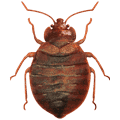
Live evidence to look for: rust-coloured fecal spots in clusters of 5-30 on the mattress seam, tan-coloured cast skins from molts (1-4 mm), live insects 3-5 mm long with a flattened oval body before feeding, engorged red-brown after. A small sticky trap placed under the staff bed leg overnight will catch nymphs even when adults are not visible.
Treatment that actually clears a Mirdif villa
There are two routes. Neither is cheap, and the wrong choice — single-room chemical only — is what creates repeat call-outs over six months.
Full-villa heat treatment is the gold standard when more than one room is positive. Industrial propane heaters raise ambient air to 50-55°C and hold for 90-120 minutes. At those temperatures bed bug eggs, nymphs, and adults all die within 7 minutes. The heat penetrates wall voids, mattresses, headboards and stored clothing without chemical residue.
For a typical Mirdif 5-BR villa with staff quarters, we run heat across the entire upper floor and the staff annexe simultaneously. Cost band AED 3,200-5,800 depending on cubic volume and air-handling complexity. One visit. No residual chemistry inside the bedrooms.
Chemical-isolated treatment works when the staff quarters are positive but the main villa is genuinely clean (verified by sticky-trap monitoring over two weeks). We treat the staff quarters fully — a residual application of bifenthrin 8% in the cracks and crevices, a desiccant dust (silica-based) in wall voids, mattress encasement, and a 21-day follow-up. AED 800-1,400. The main villa gets monthly sticky-trap monitoring for three months at AED 180/visit.
The trap that kills most Mirdif cases is electing the chemical-isolated route when the main villa is already secondarily infested. The infestation is suppressed in the staff quarters, the homeowner thinks it is solved, and four months later it surfaces upstairs.
If in doubt, run the heat.
The staff conversation
This is the part most pest control companies skip and most homeowners get wrong. The housekeeper or nanny is not the cause of the problem. She is a victim of it too. She has been bitten longer than anyone in the family. Approaching her as the source rather than as a fellow patient destroys household trust and almost guarantees you will not get accurate information about her movements, her contacts, or the room layout.
A workable script: "We've found bed bugs in the house. They're in [staff name]'s room and they're in our rooms upstairs too. They didn't start here — they always come in from outside, on a bag or on clothing or on someone's belongings. We're treating the whole villa and replacing your mattress. We'd like to know if any of your friends have had the same problem so we can warn them."
Replace, do not just treat, the affected mattress and pillows. Mattress replacement adds AED 350-800 to the bill and removes the single biggest reinfestation risk. Provide new bedding the same day treatment ends.
What this typically costs a Mirdif household
Honest May 2026 pricing for the Mirdif villa scenario:
| Scenario | Treatment | AED |
|---|---|---|
| Staff quarters only, verified isolated | Chemical + dust + encasement + 21-day follow-up | 800-1,400 |
| Full-villa heat treatment, 4-BR plus staff | Heat + encasements + 14-day follow-up | 3,200-4,800 |
| Full-villa heat treatment, 5-BR plus staff | Heat + encasements + 14-day follow-up | 3,800-5,800 |
| Replacement mattress and bedding (staff) | Mid-range mattress + sheets + protector | 350-800 |
| Monthly sticky-trap monitoring (3 months) | Per visit | 180-280 |
See our breakdown of heat versus chemical bed bug treatment for the full decision tree across UAE properties.
FAQ
Can bed bugs travel from the staff room to the upstairs bedroom without anyone touching anything?
Not in a useful timeframe at 38 metres of corridor. They almost always travel by hitchhiking — laundry, vacuum bags, mop heads, the ironing basket. If you can identify a daily back-and-forth item, that is your vector.
How long should the family leave the villa for heat treatment?
For PestSwift's protocol, six hours from the start of heating. Pets must be removed for the same window. Electronics under 60°C-rated must be relocated. We provide a pre-visit checklist.
Is chemical treatment safe for children and pets in adjacent rooms?
With bifenthrin crack-and-crevice work in a sealed staff annexe and the connecting door closed during the 4-hour re-entry window, yes. We do not use chemical residuals in the main villa for bed bug work — heat or steam only in family areas.
Will the housekeeper need a medical check?
Bed bug bites are not vectors for disease. They are itchy and emotionally distressing. A dermatologist visit for any secondary skin infection from scratching is reasonable. The household clinic should cover it as a household-acquired condition.
Mirdif bed bug cases are almost always more advanced than the family thinks at first call. If you have unexplained bites, see our Mirdif villa cockroach work for the same building-stock context — and then book a PestSwift inspection for the bed bug side. We will inspect both the staff annexe and the family bedrooms before quoting, and we will tell you honestly which route — heat or chemical — your specific case needs.
Tags
Written by
Dr. Karim El-Sayed, Lead Entomologist
PestSwift technicians and entomologists publish field-tested pest control guidance for UAE homes and businesses.