










Forty-third floor, a one-bed in one of the older Marina towers. The resident kept a spotless kitchen and still found German cockroaches on the counter every morning. She was certain they were climbing 43 floors from the bins. They weren't. They were living in the shared plumbing riser behind her kitchen wall, coming and going through the gap where the sink waste pipe passed into the stack — a two-minute commute, not a 43-floor climb.
That's the thing most people miss about cockroaches in a high-rise. In a tower, the building is one connected habitat. Your spotless flat can sit directly above an infested one and share the same vertical highway.
German cockroaches don't behave like the ones you grew up with
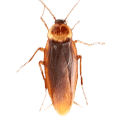
The roach causing 90% of Marina apartment calls is the German cockroach, Blattella germanica. Small, pale brown, two dark stripes behind the head. It's not the big American cockroach (the "water bug") you see scuttle across a car park at night — that one wanders in from drains and storm channels. The German one lives indoors permanently, breeds fast, and never strays far from warmth, moisture and food.
A single female carries an egg case holding 30–40 eggs and produces several in her life. Do the maths and a handful of imported roaches becomes a kitchen-wide population in a couple of months. They cluster in harbourage — tight, warm cracks — and only forage a short distance. If you're seeing them on the counter in daylight, the harbourage is already crowded enough to push them out. That's a late sign, not an early one.
The riser, the chute and the drain stack
High-rise towers concentrate three crossover routes that a villa never has:
- Plumbing risers. Every stacked kitchen and bathroom shares vertical waste and water stacks inside a service shaft. The penetration where your pipes meet the stack is rarely sealed tight. Roaches use it to move floor to floor.
- The refuse chute and chute room. The chute room on each floor is warm, damp and food-rich. It's a breeding reservoir that constantly reseeds the corridor and the nearest flats.
- AC drain lines and condensate trays. Marina towers run fan-coil units with condensate drains. A roach following moisture down a drain line ends up in your AC cupboard, then your kitchen.
This is why unit-only treatment in a tower has a ceiling on how well it can work. We can make your flat hostile, but if the riser and chute room are seeding the stack, pressure keeps arriving from outside your door.
Why the can of spray makes it worse
Surface aerosols and the over-the-counter "kill on contact" sprays do two unhelpful things to a German cockroach population. They kill the few foragers you can see while leaving the harbourage untouched, and the repellent scatters survivors — sometimes straight into the neighbouring flat or deeper into the wall void. Marina populations also show the same pyrethroid resistance we see across UAE German cockroaches, so a light spray is often more irritant than insecticide.
Fogging a flat is worse value still. The fog never reaches inside the dishwasher motor cavity, the fridge compressor housing, or the riser void — exactly where they live.
What actually clears a Marina tower flat
Our default for German cockroaches is gel bait, not spray, placed precisely where they harbour:
- Map the harbourage. We pull the kick-plate under the cabinets, check the dishwasher and washing-machine cavities, the fridge compressor recess, the sink waste penetration and the AC cupboard. In a tower the pipe penetrations are always on the inspection list.
- Gel bait into the voids. A DM-approved bait — hydramethylnon or fipronil or an indoxacarb matrix, rotated to avoid bait aversion — goes in pinhead dots inside the cavities. Roaches feed, return to harbourage, die, and the colony eats the corpses, carrying the active through the population. This secondary kill is what surface spray can never do.
- IGR to break the cycle. An insect growth regulator stops nymphs maturing, so even survivors can't rebuild.
- Seal the entry points. We seal the sink and pipe penetrations and fit a brush or escutcheon where the waste pipe enters the stack. This is the single most useful thing in a high-rise — it cuts the commute from the riser.
- Talk to the building. Where the chute room or a stack is clearly the reservoir, we recommend the owners' association arrange a riser and chute-room treatment. A coordinated stack treatment beats ten individual flats fighting the same source.
Done properly, the visible roaches drop within a week and the population collapses over two to three weeks. We hold a 90-day warranty on a standard treatment.
What it costs in the Marina
| Job | Scope | Typical cost (AED) |
|---|---|---|
| Studio / 1-BR | Gel bait + IGR + seal penetrations | 350–550 |
| 2-BR | Kitchen + both baths + AC cupboard | 500–750 |
| 3-BR / severe | Full treatment + 1 follow-up | 750–1,200 |
| Stack / chute-room (via OA) | Riser + chute room, per floor band | quoted on survey |
A note on logistics that matters in the Marina specifically: most towers only allow contractor access and any equipment through the service lift, and several restrict service-lift booking to weekday daytime hours through the building management. We sort the gate pass and lift booking with security as part of scheduling — worth knowing if you're comparing us to someone who turns up and gets turned away at the loading bay.
For a like-for-like sense of treatment in a tower kitchen, see our breakdown of German cockroaches in a JLT kitchen, and check pricing logic against our cockroach treatment cost breakdown for Dubai.
FAQ
If my kitchen is clean, why do I have cockroaches?
Cleanliness limits how big a German cockroach population can get, but it doesn't decide whether you have one. They arrive in grocery boxes, in second-hand appliances, and — in a tower — through shared risers from a neighbour's flat. A spotless kitchen sharing a stack with an infested one will still get visitors. Sealing the pipe penetrations matters more than another deep clean.
Should I ask the building management to treat the whole tower?
If the chute rooms or risers are involved — and in older Marina towers they usually are — yes. A single flat treated against a building-wide source is a holding action. Raise it with your owners' association; a per-floor stack and chute-room programme is the real fix and spreads the cost across the building.
Are the big cockroaches in the car park the same problem?
No. Those are American cockroaches living in the storm drains and basement sumps, wandering up occasionally. They need drain treatment and sump screening, not kitchen gel bait. The small striped ones in your kitchen are German cockroaches and are a different job entirely.
How long before they're gone?
Visible activity usually drops sharply within 5–7 days as foragers feed on bait and die. Full population collapse takes two to three weeks as the bait transfers through the colony and the IGR shuts down breeding. If pressure keeps arriving from the riser, that points back to a building-level source.
Seeing them on the counter in daylight? That's a crowded harbourage, not a small problem. Get an inspection — we'll find where they actually live. Our tower pest control service is built for high-rise risers and chute rooms, and you can read more on our cockroaches page or about pest control across Dubai Marina.
Tags
Written by
Dr. Karim El-Sayed, Lead Entomologist
PestSwift technicians and entomologists publish field-tested pest control guidance for UAE homes and businesses.