




The chai stall that re-seeded an entire stack
There's a 14-storey residential building near Khalid Bin Al Waleed Metro that's had four pest control companies through it in three years. Every flat in the back stack gets sprayed; six weeks later the Blattella germanica are back. The owner who pays for the contract keeps getting blamed by neighbours for cheap chemistry.
Last September we surveyed the ground floor before quoting and found the source within twenty minutes. A 24-hour chai stall on the street side, accessed through the building lobby for staff toilet and tea-rinse sink. The chai stall sink drained into the building's shared kitchen riser. The riser cavity was packed with cardboard tea-bag cartons, food residue, and a permanent harborage population running 200+ adults per square metre at the back of the void.
No amount of flat-by-flat spraying upstairs would matter while that void was active. This is the Al Mankhool problem in one job.
What's different about Al Mankhool's building stock
Al Mankhool runs from Al Karama's western edge across to the Bur Dubai corniche. The building stock is mostly 1980s through early 2000s, six to fourteen storeys, with a structural quirk that defines the pest profile.
Ground-floor retail is always wet. Look at the ground floor of any Al Mankhool residential building on Mankhool Road, Al Hubob Street, or Khalid Bin Al Waleed Street. You'll find chai stalls, samosa shops, mobile-repair counters that also sell drinks, electronics shops with a back-room tea station. Every one of them has a small sink, a fridge, and food residue. The drain on that sink goes into the same kitchen riser as the flats above.
The kitchen risers don't have a service-trap. Newer Dubai buildings (post-RERA 2007) require kitchen waste risers to have an accessible trap at each floor, sealed against vermin migration. Al Mankhool's older stock pre-dates that. The riser is a continuous 4-inch cast-iron stack from ground to roof with whatever's growing inside it for the last 30 years.
Bathroom drain stacks share cockroach traffic. German cockroaches in this generation of building use the bathroom waste stack as a secondary highway. Cold water risers stay wet at every joint. Open a sink trap inspection plate on the eighth floor and you'll find adults pacing the pipe wall.
Honestly, half the calls I take from Al Mankhool start with 'I've sprayed three times and they come back.' Of course they do. The flat was never the harborage.
German cockroach biology, applied to this building
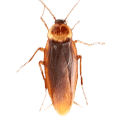
Blattella germanica is the species you'll see 9 times out of 10 in Al Mankhool flats. American cockroaches (Periplaneta americana) appear too, mostly in basement parking and ground-floor service rooms, but the upstairs problem is German.
Four facts that drive the treatment plan.
German cockroaches don't live where you see them. They live behind, under, and inside — fridge compressor, dishwasher motor cavity, under-sink cabinet floor, microwave back vents, behind kickplates, in cardboard storage. The 10% you spot at night is the foraging cohort. The other 90% never leave the harborage.
They thermoregulate. The kitchen is their preferred microclimate at 27–32°C with 60%+ RH. Al Mankhool flats that run their AC at 24°C all day still have a 30°C zone behind the fridge motor and 35°C inside the dishwasher.
They aggregate by faeces pheromone. Drop a piece of cardboard with cockroach droppings on it and the population will accumulate there within 72 hours. This is the trick gel-bait exploits.
They breed fast. A female carries one ootheca to maturity per cycle (16 eggs), and at Al Mankhool kitchen temperatures she produces a new ootheca every 3–4 weeks. Each generation reaches adulthood in about 100 days. Miss the egg cycle and you're starting over.
What we actually do in these buildings
The protocol has to address the riser and the flat together. Single-flat treatment alone doesn't hold past six weeks.
In the flat
Hydramethylnon gel-bait placed in 8–14 dosed spots per kitchen, weighted toward dishwasher motor cavity, fridge compressor housing, under-sink cabinet hinges, kickplate undersides, and microwave back vents. The bait is the active mover — workers feed, return to the harborage, defecate the toxicant, and the rest of the colony eats the corpses. One properly placed gel job kills more cockroaches than three perimeter sprays.
Insect growth regulator (IGR) — pyriproxyfen — injected into wall voids behind the sink cabinet and microwave. IGR sterilises adults and arrests nymphs at moult. This is the egg-cycle cover.
Imidacloprid behind kickplates only. No surface spray on visible kitchen surfaces. Gel + IGR is the spine; spray only goes where humans don't touch.
In the riser
Riser cap inspection. We open the kitchen waste riser at the service-floor inspection point (usually a steel access door in the building's back stairwell) and confirm the population. If active, we treat the riser cavity with a methoprene + boric acid dust at 200 g per metre of stack, then re-seal with a temporary mesh while the building manager arranges a permanent service-trap retrofit.
Ground-floor retail audit. We don't fix the chai stall's sink — that's the owner's plumber — but we document the back-room conditions for the building manager. Dubai Foodwatch registration is required for any commercial premises serving prepared food. We've flagged unregistered shops to DM Foodwatch when the building owner wouldn't otherwise act.
21-day re-treatment
One gel pass kills the foraging cohort and the workers. The 21-day re-treatment kills the cohort that hatched from oothecae in the wall void since the first visit. Without re-treatment we'd be back inside two months.
What it costs in Al Mankhool
Real numbers, AED, VAT-included, single-flat:
- 1-BR flat, kitchen-only treatment: 320–480
- 2-BR flat, kitchen + 2 bathrooms: 400–650
- 3-BR flat, full treatment + IGR: 550–850
- 21-day re-treatment: included in the quoted price
- Riser-cap retreatment (building manager pays): 800–1,800 per stack per visit
The building-stack treatment costs more in absolute terms but per-flat it works out to about 30% of a standalone job because we mobilise once.
The Karama and Bur Dubai borders
Al Mankhool's eastern edge bleeds into Al Karama at Karama Park. The building stock is similar. We see the same German cockroach reinfestation pattern at the Al Karama old buildings and on the Bur Dubai side, with the same shared-kitchen-riser cause. If you're on a corner block and you're not sure which neighbourhood you're technically in, the treatment plan is the same.
FAQ
Why do cockroaches come back two weeks after a spray in Al Mankhool flats?
Because the spray killed the visible population (the 10% foraging cohort) but left the wall-void harborage alive, and the kitchen riser was never touched. The population rebuilds from inside the building's infrastructure, not from outside.
Do the ground-floor shops in Al Mankhool really cause cockroach problems upstairs?
Yes, when their sinks drain into the building's kitchen riser. Not every ground-floor shop does this — some are on a separate stack. The way to tell is to ask the building manager which shops share the riser with which flats. If the answer is 'I don't know', that's the answer.
Is gel-bait safe for children and pets in an apartment?
Dosed correctly it is. We apply gel in 0.03 g dots inside cavities children and pets can't reach (dishwasher motor, fridge compressor housing, inside-cabinet hinge channels). The active ingredient (hydramethylnon) has a mammalian oral LD50 around 1,100 mg/kg — a 10 kg toddler would need to eat the contents of about 35 dispenser cartridges to reach a toxic dose. We still place every dot out of line-of-sight. See our pet-safe, baby-safe pest control guide.
Will my flat get re-infested if my neighbours don't treat?
Maybe, depending on whether you share a kitchen riser with them. If you do, yes — the population in the riser will re-seed your flat within 6–8 weeks. That's why we push for stack-treatment with the building manager rather than single-flat work. For the cost economics of that conversation, see our whole-building pest control cost guide.
Book a survey
If you're in Al Mankhool and you're tired of the six-week cycle, book a free survey. We'll inspect your flat and the building's shared kitchen riser before quoting, so you know what you're paying for.
Tags
Written by
Dr. Karim El-Sayed, Lead Entomologist
PestSwift technicians and entomologists publish field-tested pest control guidance for UAE homes and businesses.