

Twenty minutes after a sheep is butchered in a 42°C villa courtyard, the first blowfly is on the carcass. Within an hour there are dozens. By the time the family has finished portioning the meat for the freezer, the kitchen counter has Chrysomya bezziana eggs in places nobody saw them being laid.
This is the Eid al-Adha pest control conversation almost no one in the UAE pest control industry actually has with their customers. We get asked about pre-Eid villa cleaning, pre-Eid mosquito treatments, even pre-Eid wasp removal. We almost never get asked the question that matters most for villa households planning a Qurbani at home or accepting a large meat delivery from a slaughterhouse: how do you keep the meat fly-free in 40°C+ heat during the four to six hours it takes to process and distribute?
Eid al-Adha 2026 falls around 26-29 May. This year more than most years, the meat-handling window overlaps with the start of peak fly season in the UAE.
What's actually flying
Three fly species do almost all of the damage to fresh meat in UAE residential settings:
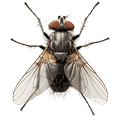
Chrysomya bezziana — the Old World screw-worm fly. Bright metallic green-blue, slightly larger than a housefly. Females locate fresh meat (or any moist protein) by smell from up to 200m and lay 150-200 eggs in a single mass. Eggs hatch into larvae within 8-12 hours at 35°C+. This is the headline threat.
Lucilia sericata — common green bottle fly. Similar behaviour, smaller egg mass (50-100), and usually arrives slightly later than Chrysomya.
Musca domestica — the standard housefly. Doesn't lay directly on whole meat as readily as the blowflies but will swarm to meat juices, sauce residues on counters, and the courtyard rinse water from processing.
In an open-air Qurbani setting at 42°C, you're looking at all three within the first 30 minutes. The reason most pest control sprays are wrong here is that we're not trying to kill flies that have already landed — we're trying to prevent eggs and larvae from contaminating meat that's going into your freezer.
What pest control should NOT do during Qurbani
Two things to rule out first:
Don't spray pyrethroid residual on or near the meat-handling surface. Even DM-approved pyrethroids leave a residue. Permethrin, deltamethrin, lambda-cyhalothrin — none of these are food-contact safe. If a technician arrives the morning of your Qurbani with a pump sprayer and offers to "treat the kitchen for flies before the meat comes in," that's a non-starter. The treatment has to happen the day before and the surfaces have to be wiped down before food handling resumes.
Don't use a thermal fogger in the courtyard while meat is being processed. Fog deposits sub-micron droplets on every exposed surface, including raw meat. Wrong tool for this job.
What you want instead is a combination of physical exclusion, UV/glue traps, and a pre-Eid residual placed only on non-food surfaces.
The PestSwift Eid protocol
For a villa hosting Qurbani at home, or accepting a 25kg+ slaughterhouse delivery for in-villa portioning, we recommend a two-stage approach.
Stage 1: Day before (24 hours pre-Eid)
A 60-90 minute technician visit. Two tasks:
- Inspect and seal exterior fly entry points. Window screens checked for tears, courtyard door brushes inspected, AC vent screens checked. Most villas have at least one compromised screen. We patch on the spot.
- Place UV light traps and glue boards at strategic interior points. UV traps go on a wall 1.5-2m above floor level, away from competing light sources, in the corridors leading to the kitchen. Glue boards (we use the Catchmaster type — non-toxic glue, no insecticide) go on top of fridge units, behind appliances, and on the courtyard side of the kitchen door threshold.
For the courtyard if you're processing meat outdoors, we recommend a temporary fly-screen marquee (some customers rent these from event suppliers for AED 250-450/day). We don't sell or install marquees; we tell you which ones work.
Stage 2: Same-day standby
For customers who need it, we keep a technician on call during the 8am-2pm Eid morning window to respond if a fly issue emerges (e.g. the screen tears mid-process, or there's a courtyard breach). AED 350 standby fee, AED 200/hour if called out. Most years we get called by 2 of every 10 customers who set up Stage 2.
What it costs
| Service | Cost |
|---|---|
| Pre-Eid villa inspection + UV trap + glue boards (one-off, day before) | AED 350-600 |
| Above + temporary marquee recommendation + sealant work | AED 600-900 |
| Same-day standby (8am-2pm) | AED 350 retainer + AED 200/hr if called |
These prices are inclusive of equipment that stays with you after Eid — the UV traps and glue boards become a permanent kitchen fly management upgrade. The traps run on standard power and consume about AED 6 of electricity per month.
Slaughterhouse delivery vs in-villa Qurbani
The Dubai Municipality and ADPHC slaughterhouse system handles tens of thousands of Qurbani sacrifices on Eid day. If you've used an approved slaughterhouse via TAMM or Dubai Now — the standard route — your meat arrives pre-portioned and chilled. Fly exposure starts when you open the bags at home.
For a slaughterhouse delivery being broken down for distribution at home (the common pattern in extended-family arrangements where one household processes and distributes to 3-5 others), keep the meat in the chilled bags until each portion is going directly to a freezer. Don't lay multiple portions out on a counter for an hour while you wait for relatives to arrive.
For in-villa Qurbani — much rarer but still done — the fly pressure is roughly 5x what a slaughterhouse delivery generates because the carcass is exposed during the entire processing window, not just the final distribution step.
A practical residual you CAN use
If you want a residual that goes down 24 hours pre-Eid and is safe to have in a kitchen by the time meat is handled, the option we use is a pyriproxyfen application — an insect growth regulator that sterilises adults but has no acute toxicity profile. Pyriproxyfen is approved for food-handling premises by Dubai Municipality and is the same active that licensed restaurant pest control contractors use.
We apply pyriproxyfen as a fine residual on the EXTERIOR side of door frames, screens, and courtyard wall surfaces — never inside the kitchen. The effect: any female blowfly that lands on those surfaces during pre-Eid will fail to develop fertile eggs.
What you should do without us
Three things every villa household processing meat at Eid should do, with or without a pest control contractor:
- Refrigerate or freeze meat within 4 hours of receipt. The 4-hour window is roughly the time it takes for blowfly eggs (if laid) to hatch into larvae at UAE summer temperatures.
- Cover meat with food-safe muslin or fine mesh during any unavoidable exposure. Not plastic film — meat needs to breathe — and not standard fly net, which has too-wide mesh.
- Manage the kitchen exhaust. Run the kitchen exhaust fan during processing and 30 minutes after. Fly attraction is driven by volatile odour, and removing the odour plume cuts incoming traffic significantly.
FAQ
Can flies actually lay eggs on cooked meat? Mostly no. The egg-laying response is driven by raw meat amino acid and ammonia volatiles. Cooked meat lacks the strongest attractant signals. But cooked meat that has been sitting out for 30+ minutes can attract houseflies that contaminate the surface with bacteria from previous landing sites.
Is fly spray safe to use during Qurbani? Aerosol pyrethrin sprays applied directly to flying flies (not surfaces) are technically safe in the airspace but the droplets settle. Don't use them inside the meat-handling zone. Outside the kitchen, away from open meat, they're fine.
My slaughterhouse delivery sat on the courtyard floor for 90 minutes before we opened it. Should I throw it away? If the bags were sealed, the meat inside is fine — flies cannot penetrate intact plastic. If the bags were open or torn, inspect the surface for clusters of cream-coloured eggs (~1mm). If you find any, that meat is contaminated and should be discarded. If clean, refrigerate immediately.
Will a UV trap actually catch blowflies? Yes, but not as efficiently as it catches houseflies. Blowflies are more attracted to food odour than to UV. UV traps are a backup, not the primary intervention — exclusion and same-day chilling are primary.
If you're hosting Eid at home this year and you want a proper pre-Eid villa walk plus same-day standby, book your slot before 22 May. We run a limited number of slots on Eid morning and they fill up the week before.
Tags
Written by
Maria Fernandez, Commercial Accounts Lead
PestSwift technicians and entomologists publish field-tested pest control guidance for UAE homes and businesses.