



Three different small flies turn up in UAE kitchens every summer, and almost everyone calls all of them "fruit flies." They're not, and the mix-up is why a can of fly spray never fixes the problem. The little flies hovering over your fruit bowl, the slightly fuzzy ones clinging to the sink, and the ones drifting up from a potted plant are three separate insects breeding in three separate places. Kill the adults and you've done nothing about the breeding source — so they're back by morning.
Summer makes it worse fast. Heat compresses the fly life cycle to about a week, so a handful of flies becomes a cloud in days. The fix is never spray. It's working out which fly you have, finding where it breeds, and removing that.
The three small flies you're actually dealing with
Fruit flies — the fruit bowl hoverers
Fruit flies are about 3 mm, tan, often with red eyes, and they hover around ripening or fermenting fruit and anything sweet. They breed in the film of fermenting sugars on over-ripe fruit, the recycling bin, the bottom of the rubbish bin, a forgotten potato in the cupboard, or the residue in a soft-drink can. In UAE homes the fruit bowl left out in a warm kitchen is the classic source, closely followed by the recycling no one rinsed.
A female lays hundreds of eggs on that fermenting surface, and in summer heat the new adults emerge in roughly a week. That's why the numbers seem to explode overnight.
Drain flies — the fuzzy sink dwellers
Drain flies (sometimes called moth flies) are a little bigger, darker, and look fuzzy or moth-like, holding their wings in a roof shape. You'll see them resting on walls near the sink, on the splashback, or around a floor drain — they're weak fliers that don't stray far from where they breed.
And where they breed is the giveaway people miss: the gelatinous organic film inside drains, the overflow pipe, the U-bend, the rarely used guest bathroom floor drain, the AC condensate drain. They don't come from your fruit at all. No amount of cleaning the counter touches them, because the larvae are living in the slime inside the pipe.
Fungus gnats — the houseplant flies
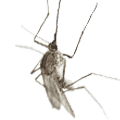
Fungus gnats are tiny, dark, delicate, long-legged flies that drift weakly around potted plants. They breed in the moist, organic potting soil, especially when a plant is over-watered. With more UAE homes keeping indoor plants under AC, these have become a regular summer call. The flies themselves are harmless; the tell is that they rise from the soil when you water.
How to tell them apart in ten seconds
- Hovering over fruit, bins or sweet drinks, red-eyed → fruit fly. Source: fermenting food/recycling.
- Sitting near the sink or a drain, fuzzy and moth-like → drain fly. Source: organic film inside a drain.
- Rising from plant pots when watered, delicate and long-legged → fungus gnat. Source: wet potting soil.
Where they rest and breed identifies them more reliably than how they look. That matters, because the fix is completely different for each.
Why fly spray is the wrong tool
Aerosol fly spray kills the adults you can see and leaves every egg and larva untouched in the breeding source. Since those sources are pumping out new adults daily — faster in summer heat — you're emptying a can to buy a few hours. It's the same trap as spraying cockroaches on the counter: you hit the symptom and ignore the source.
There's also no need for fogging a home for small flies. Fogging is a heavy intervention for the wrong problem. Source removal is quieter, cheaper and permanent.
The fix, fly by fly
Fruit flies: Find and remove the fermenting source — bin the over-ripe fruit, take out and rinse the recycling, empty and wash the bins, check under the fridge and in cupboards for a forgotten item. Keep fruit in the fridge during summer. A simple cider-vinegar trap mops up the remaining adults while the source-removal does the real work.
Drain flies: This is a drain-cleaning job, not a surface one. The organic film inside the pipe has to be physically broken down — a drain brush plus an enzyme or bio-drain cleaner, repeated, clears the larval habitat. Pouring bleach down briefly knocks adults back but rarely removes the film. Identify which drain by taping a cup over each overnight and seeing where flies collect.
Fungus gnats: Let the potting soil dry out between waterings, since the larvae need constant moisture. Removing the top layer of soil and not over-watering usually ends it.
For a heavy or persistent case — or when you simply can't find the source — that's where we come in. We trace the breeding site, treat the drains properly, and confirm it's gone. The drain side in particular overlaps with what we handle in commercial kitchens; our piece on drain fly control in a Dubai food court shows the same principle at scale. And if the "flies" near your AC turn out to be tied to the condensate line, that connects to the wider summer issue we cover in AC drain mosquito breeding.
And the house fly — the bigger summer nuisance
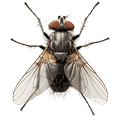
The classic house fly (Musca domestica) is the larger grey fly that comes in off the balcony and circles the kitchen. Unlike the three small flies above, it usually breeds outside — in the communal bin store, a neglected balcony bin, pet waste, or organic matter near the building — and flies in through open doors and windows, drawn to food smells and cooking.
House flies matter for hygiene more than the others: they feed and breed on waste, then land on food and surfaces, mechanically carrying bacteria. The fix is mostly exclusion and sanitation — keep kitchen bins sealed and emptied, fit or repair window screens, clear any balcony food waste, and lean on the building to keep the communal refuse room clean and closed. Indoor sprays do little when the source is the bin store downstairs; the lasting answer is denying them the breeding waste and the way in.
Keeping a summer kitchen fly-free
- Don't leave fruit out in a hot kitchen — fridge it.
- Rinse recycling before it sits in the bin.
- Empty and wash bins regularly; check the bin base for residue.
- Run and clean rarely used drains so the trap doesn't dry out and so film doesn't build.
- Don't over-water indoor plants.
FAQ
Why do I suddenly have small flies in my kitchen in summer? Heat shortens the fly life cycle to about a week, so a small breeding source — fermenting fruit, a filmy drain, or wet plant soil — produces adults fast and numbers climb quickly. The flies were always breeding somewhere; summer just speeds it up.
What's the difference between fruit flies and drain flies? Fruit flies are small, tan, often red-eyed, and hover around fruit, bins and sweet residue. Drain flies are darker, fuzzy and moth-like, rest near sinks and drains, and breed in the organic film inside pipes. They come from different sources and need different fixes — which is why telling them apart matters.
Do fruit flies come from the drain? Usually not — those are drain flies. True fruit flies come from fermenting food and recycling. If the flies are fuzzy and gather near the sink or a floor drain, you have drain flies, and the fix is cleaning the inside of the drain, not the counter.
Will fly spray get rid of them? Only the adults you hit, for a few hours. It does nothing to the eggs and larvae in the breeding source, which keep producing new flies. Removing or treating the source — fruit, drain film, or wet soil — is the only thing that actually ends it.
Can't find where they're breeding? Book an inspection and we'll trace the source and treat it. More on fly biology and control and our apartment pest control service.
Tags
Written by
Dr. Karim El-Sayed, Lead Entomologist
PestSwift technicians and entomologists publish field-tested pest control guidance for UAE homes and businesses.