
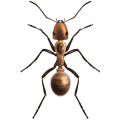
It usually starts at the kitchen sink. A faint trail of tiny pale-brown ants threading from a hairline gap in the tiling to a drop of water by the tap, then a few days later a second trail, then a third heading for the bin. By the time most UAE households call us in June, what looked like a few ants has quietly become several nests.
Summer is ant season indoors, and the reason is simple: when it's 45°C and bone dry outside, your air-conditioned kitchen is the most hospitable place for miles. Cool-ish, humid near the sink, and full of food and water. The ants aren't invading so much as relocating to the best real estate around.
Why heat drives ants indoors
Ants are governed by temperature and moisture. The two species that plague UAE kitchens — the pharaoh ant and the tiny ghost ant — both favour warm, humid conditions around 26–30°C with high humidity near water. Outdoors in peak summer the ground bakes and surface moisture vanishes, so foraging ants follow the cool, damp gradient indoors: under doors, through window gaps, along pipe and cable entry points, up through the slab where plumbing rises.
Once inside, they find everything a colony needs. AC condensate trays and drain lines provide water. Wall voids behind the kitchen, the gap under the sink, and the cavity behind skirting provide warm, hidden nest sites. And the kitchen provides a 24-hour buffet. So the summer trail you see isn't a passing nuisance — it's scouts mapping a new home.
The two species that matter (and one rule)
Pharaoh ants are the hard ones. They're tiny — about 2 mm — yellow to light brown, and they build sprawling colonies with multiple queens and multiple nests that stay connected. They nest in wall voids, behind baseboards, around pipes and warm appliances, and they're active indoors year-round, with call-outs peaking in summer.
Ghost ants are even smaller, with a dark head and a pale, almost translucent abdomen. They behave similarly — many queens, many satellite nests, a love of moisture and sweets.
Here's the one rule that matters for both: do not reach for the spray can. This is the most important and most counter-intuitive thing about summer ants in the UAE.
Why supermarket spray makes it worse
Spraying a pharaoh or ghost ant trail feels satisfying — the visible ants die. But these species respond to chemical stress by budding: queens and workers split off and start new satellite nests elsewhere in the building. So you kill the trail you can see and trigger three new colonies you can't. People who spray weekly all summer are often the ones who end up with ants in every room by August.
It's the same logic behind so much failed pest control — hit the symptom, scatter the source. With multi-queen ants it's especially punishing because the colony is built to survive exactly this kind of attack.
What actually works: bait, don't spray
The fix is slow-acting bait, matched to what the ants are feeding on. Foragers carry the bait back to the nest and feed it to the queens and brood, collapsing the colony from the inside — including the satellite nests you never found.
Our summer ant protocol looks like this:
- Identify the species and the trails. We follow the lines back toward entry points and likely nest sites, and check whether they're after sweets or protein/grease (it shifts with the colony's needs).
- Place matched gel and liquid baits along the trails and at entry points — never a repellent spray near the bait, which would just break the trail and stop them feeding.
- Address moisture. We point out the leaking trap, the over-full AC condensate tray, the damp under-sink cabinet — because a dry kitchen is far less attractive.
- Seal entry points where practical: gaps under doors, around pipe penetrations, window seals.
- Review after 1–2 weeks. Multi-queen colonies take a little time to crash; we top up bait and confirm the trails are gone.
It's quieter and slower than spraying, but it's the only thing that actually ends a pharaoh or ghost ant problem rather than scattering it. The same budding mechanism — and why baiting beats spraying — is something we go deeper on in our piece on pharaoh ants budding in Dubai apartments.
A health note people forget
Tiny kitchen ants aren't just annoying. Pharaoh ants in particular can mechanically carry bacteria such as Salmonella and Staphylococcus across surfaces, which is why they're treated seriously in hospitals and food premises. In a home kitchen it's another good reason not to let a summer trail become a permanent colony.
What you can do before we arrive
- Don't spray. Resist it. If you've already sprayed, stop — it scatters the colony.
- Cut the water. Fix drips, wipe the sink dry at night, empty AC condensate trays.
- Remove the food. Seal sugar, honey, dates and pet food in airtight containers; wipe up spills immediately.
- Wipe trails with soapy water to erase the scent path — this slows them without triggering budding the way insecticide does.
- Note where they enter. It helps us target baiting and sealing.
Finding the nest you can't see
The frustrating thing about multi-queen ants is that the nest is almost never where the food is. The trail leads to a crumb on the counter, but the colony is tucked in a wall void ten feet away. We look for a few giveaways during inspection.
Trails that disappear into the same crack day after day point to a nest behind that wall or under that unit. Ants that stream from a power socket or light switch are usually nesting in the warm cavity around the wiring — a classic pharaoh ant site. A line running to a potted plant often means the nest is in the moist soil. And trails concentrated under the sink or behind the fridge point to the warm, damp voids those appliances create.
We follow the heaviest trails to the entry point and bait there, because bait placed on the path the foragers already use gets carried home fastest. Chasing individual ants around the counter with a cloth, by contrast, does nothing to the queens — and they're the only part of the colony that matters.
FAQ
Why do tiny ants suddenly appear in my kitchen in summer? Because your air-conditioned, slightly humid kitchen is far more hospitable than the scorched, dry conditions outside. Foraging ants follow the cool, moist gradient indoors and find water at the sink and AC drains plus food everywhere — so summer pushes them in.
Do over-the-counter ant sprays make pharaoh ants worse? Yes. Pharaoh and ghost ants react to spray by budding — splitting into new satellite nests with their own queens. You kill the visible trail and create several hidden colonies. Slow-acting bait carried back to the queens is what actually works.
Are these tiny ants dangerous? They're mainly a nuisance, but pharaoh ants can carry bacteria like Salmonella and Staphylococcus across surfaces, so they're a genuine hygiene concern in kitchens — and a serious one in hospitals and food businesses.
How long does ant baiting take to work? You'll usually see trails thin out within a few days, but fully collapsing a multi-queen colony takes one to two weeks as the bait reaches every satellite nest. That patience is the price of an actual fix rather than a temporary knock-down.
Losing the summer battle at the kitchen sink? Book an inspection and we'll identify the species and bait it properly. More on ant biology and control and our apartment pest control service.
Tags
Written by
Dr. Karim El-Sayed, Lead Entomologist
PestSwift technicians and entomologists publish field-tested pest control guidance for UAE homes and businesses.