
Spray a normal trail of black ants and the trail dies. Spray a trail of pharaoh ants and within ten days you have ant trails in three rooms instead of one. Within a month, two of your neighbours start complaining too.
This isn't an exterminator's failure or a stronger species. It's a behaviour called budding, and it's the single most important thing to understand about Monomorium pharaonis in a UAE high-rise.
We see roughly 25 to 40 pharaoh ant cases a month across Dubai. Most arrive at us after the homeowner has tried Raid, Baygon, vinegar, lemon juice, peppermint oil, and a Lazada-bought ultrasonic plug. Each of those responses, in slightly different ways, has made the colony harder to control.
Identifying pharaoh ants — they're not the regular Dubai ant
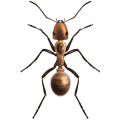
The small ant trails most Dubai apartments see are usually black crazy ants (Paratrechina longicornis) or ghost ants (Tapinoma melanocephalum). Pharaoh ants are different. Three identification cues:
- Size: 1.5 to 2 mm. Distinctly smaller than the average Dubai ant. Workers are uniform in size.
- Colour: Yellowish to light reddish-brown body, with a darker abdomen tip. They look almost translucent in good light.
- Trails: Faint, thin, and often along ceiling corners or electrical conduits rather than on countertops. They forage at night more than day.
The diagnostic test if you're unsure: put a tiny smear of peanut butter and a tiny smear of honey on a kitchen tile, leave it for two hours after dinner. Pharaoh ants will preferentially recruit to the protein. Ghost and crazy ants prefer the sugar. This isn't conclusive but it's a strong first signal.
If the species is pharaoh and you're in a tower (Marina, JLT, Business Bay, Dubai Hills, Al Reem), assume the colony is using the building's electrical and plumbing conduits to reach you, and assume your immediate neighbours are at risk.
What budding actually is
Most ant colonies have a single queen who controls reproduction. Kill the queen and the colony dies in weeks. Pharaoh ant colonies have multiple queens — a typical mature colony has 100 to 200 reproductive queens — and they reproduce by fission rather than nuptial flights.
When the colony is stressed (chemical spray, heat, sudden temperature change, physical disturbance), a portion of the workers grab a queen, several dozen brood, and walk to a new nest site. The original colony continues. The breakaway colony establishes. Where there was one colony, there are now two.
This is why every aerosol can of insect spray your apartment building has ever applied to a pharaoh ant trail has made things worse. The chemical doesn't reach the queens — they're in a void you can't see — and the contact with workers triggers exactly the stress response budding evolved for.
DIY approaches that all trigger budding to some extent:
- Aerosol surface sprays (Raid, Baygon, generic pyrethroids)
- Boiling water poured on visible trails
- Vacuuming a trail (less than spraying, but still a stress signal)
- Caulk-sealing a foraging route mid-day
- Vinegar or lemon-juice barriers
The one DIY approach that doesn't trigger budding is doing nothing while you call a technician. Genuinely. Don't disturb the trail.
What actually controls pharaoh ants
Gel-bait. Specifically, slow-acting gel-bait with a transferable active ingredient. The two reliable chemistries:
- Hydramethylnon in a sweet-protein matrix (Maxforce, similar). Workers eat the gel, share it via trophallaxis, the queens eat second-hand and die. Population collapses over 3 to 6 weeks.
- Boric acid in a sucrose matrix at 1 to 5% loading. Slower (4 to 8 weeks) but exceptionally safe and rarely repels.
Fipronil bait has technically faster knockdown but at higher worker mortality, which can trigger budding in some pharaoh ant strains. We use it more selectively than the other two.
The protocol for a pharaoh ant call in a UAE apartment:
- Inspection without disturbing trails. We map activity using a low-light visual survey. No spraying, no vacuuming.
- Bait placement at trail intercept points. Discreet bait gel droplets every 1 to 2 metres along active trails, behind appliances, inside electrical socket cavities, near plumbing penetrations. Typically 15 to 25 placements for a 1-BR.
- No follow-up spraying. We tell the homeowner explicitly: do not spray, do not move bait stations, do not clean the surfaces near placements.
- Two-week and four-week monitoring visits. Bait gets replenished where consumed, new placements added if activity has migrated.
- Six to twelve week resolution window. Pharaoh ant control is not a one-shot job. Anyone quoting a single-visit fix on a confirmed pharaoh ant infestation is selling you a bid for a callback.
Cost for a 1-BR pharaoh ant programme in Dubai: AED 700 to AED 1,100 across the three-visit course. Cost for a 3-BR villa: AED 1,200 to AED 1,800. The single-visit AED 149 quote is selling a fundamentally different product.
Why high-rises are pharaoh-ant-friendly
A Marina or JLT tower has continuous electrical conduit running between every apartment, branched cable trays in ceiling voids, and shared plumbing penetrations through fire-rated wall barriers. The fire-stopping foam used in those penetrations is breathable enough that ants can navigate through it.
We've documented pharaoh ant trails over 35 metres long inside ceiling voids in Marina towers. The colony was nesting near a hot-water riser two apartments away from the unit complaining of the trail. Treating just the visible trail in the complainant's apartment would have triggered budding and spread the problem.
For any pharaoh ant case in a tower, our default scope is:
- The complainant's unit, full bait protocol
- Common-area bait at the nearest accessible service shaft (with FM permission)
- A polite knock on adjacent units (sometimes the pattern reveals an obvious source)
FM coordination matters. The Marina and JLT FMs we work with regularly understand the pharaoh ant problem. Newer building managers sometimes need education. We send a one-pager.
Frequently asked questions
Are pharaoh ants harmful to humans?
They don't bite or sting in any consequential way. The medical concern is in healthcare and food settings — pharaoh ants have been documented carrying Salmonella, Pseudomonas, and Streptococcus between locations, including into IV ports and surgical wounds in hospital case reports from outside the UAE. For a UAE apartment household, the risk is contamination of food preparation surfaces and the practical nuisance of a colony you can't easily clear.
Can I trap pharaoh ants without using gel bait?
No trap-based approach controls a pharaoh ant colony. Sticky traps catch foragers without affecting reproduction. Bait-and-discard products that knock down workers fast trigger budding. The combination of a slow-acting transferable active and patience is the only protocol that works.
How do I know if my problem is pharaoh ants and not just regular ants?
The protein-vs-sugar bait test on a tile is a strong first cue. Visual identification — yellowish 2 mm workers on faint ceiling-corner trails — is fairly distinctive. If you're uncertain, photograph a worker on a neutral background (white paper) and send it to us; we can usually identify from a phone photo.
Will a building neighbour's spraying ruin my treatment?
It can. If a neighbour applies aerosol pesticide to their unit during your treatment course, the budding response can push a portion of the colony into your apartment regardless of your bait placements. We coordinate with FM to send an advisory note to the floor when possible. Apartment neighbours often appreciate the heads-up.
Get the right protocol from day one
If you have small yellowish ants on faint trails along your ceiling corners or skirting in a Dubai apartment, please don't spray. Take a photo, contact us, and let an inspection confirm the species before any chemical touches the trail. Mistakes at the first treatment cost weeks of additional work.
For more on UAE ant species in general, see our ant pest profile. Marina-based readers can also see our Dubai Marina pigeon-proofing post for high-rise-specific service logistics.
Tags
Written by
Dr. Karim El-Sayed, Lead Entomologist
PestSwift technicians and entomologists publish field-tested pest control guidance for UAE homes and businesses.