

Eid Al Adha falls on Wednesday 27 May this year — eight days from publication. Crescent moon sighting has been confirmed across the Gulf, the private-sector long weekend is locked, and every 4- and 5-star property between Ras Al Khaimah and Liwa is finalising its Eid buffet plan. Madinat, Saadiyat, Yas, the Palm, the Corniche cluster. Lamb ouzi stations under banquet tents, slow-roast goat carving, mansaf and harees served from chafer dishes to 200–800 guests across multi-hour service windows.
It is the most pest-pressured week of the UAE F&B year.
If you operate hotel banquet F&B and you have not finalised your buffet fly plan by today, your DFSD inspector will arrive on day one of the holiday with a measuring window and a clipboard.
Why Eid Al Adha is different
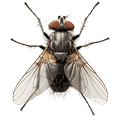
Westerners catering an outdoor wedding deal with house flies. Hotel F&B on Eid Al Adha deal with blow flies — and the species matters.
Lucilia sericata (green-bottle blow fly) and Calliphora vicina (blue-bottle blow fly) are drawn to fresh meat scent at concentrations human noses can't detect. Field studies put their olfactory range for fresh lamb at 800–1,200 m on a still day, up to 2 km in a moderate downwind condition. A single uncovered ouzi tray on an outdoor terrace pulls 40–60 flies within 25 minutes during the late-afternoon temperature peak (38–44°C exterior, 30–34°C inside the banquet tent canopy). Gravid females lay 200–300 eggs per oviposition. The eggs hatch in 8–12 hours at that temperature. You can have a maggot problem in your trim-waste bin before service finishes.
House flies (Musca domestica) are still the highest-count species across the venue — they swarm the open buffet line, the bread station, the dessert table. Their range is shorter (200–400 m) but their numbers are 5× higher. They're the species your guests will photograph.
Drain flies (Psychodidae) and fruit flies (Drosophila) live in the prep kitchen, drain biofilm, fruit-juice spills. They rarely cross into the guest zone but they get logged at the back-of-house inspection.
Dubai Food Safety Department — what the inspector measures
DFSD treats hotel outdoor buffet zones as a critical control point under HACCP. The published sustained-presence trigger is >3 flying insects per 30-minute observation at any meat station. Cross that and the inspector writes it up immediately. Sustained findings trigger the F&B operation suspension — for the duration of the buffet service if a single station, longer if multiple.
ADPHC runs parallel rules for Abu Dhabi venues. The Saadiyat and Yas cluster hotels are inspected by ADPHC F&B inspectors during major holiday peaks. Sharjah Municipality and Ajman Municipality apply similar standards.
The documentation requirements during the audit window:
- Active pest control contract on file, dated within current month, naming the DM/ADPHC-licensed PCO
- Visit reports for the previous 12 months
- Pre-event treatment record (chemical name, application date, applicator ID)
- Fly-count log per station per 30-minute interval during service
- Trap maintenance log (replacement date, capture count)
- Air-curtain calibration record (where applicable)
If any one of those is missing, the inspector escalates regardless of actual fly count.
The protocol that holds during Eid week
Three zones, three different tactical approaches.
Zone 1: pre-event perimeter (48–72 hours before service)
The goal here is to reduce the inbound fly population before guests arrive.
- Lambda-cyhalothrin SC residual on all landscape vegetation within 30 m of the banquet zone — applied 48 hours minimum before service to allow drying + neutralisation of any odour. Active for 14–21 days.
- Deltamethrin SC on outdoor banquet tent fabric (inside + outside surfaces), outdoor furniture stacks (banquet chairs in storage, table linen carts before deploy), and the perimeter fence/screen line.
- Beta-cyfluthrin on the rear-of-house pathway from the kitchen prep exit to the buffet line. This is the route catering staff use during plate-up — a fly-free corridor matters.
- Bio-foam drain treatment in every back-of-house floor drain on the prep kitchen side. Eliminates Drosophila + drain-fly larval reservoirs that would otherwise emerge during service.
Zone 2: active buffet station (service window)
- Sealed glass-lid carving stations. No open trays under any condition. Yes, this means the carving knife operator opens the lid per-guest. Every reputable hotel buffet operator at this scale has glass-lidded carving cabinets — they are the difference between passing and failing DFSD.
- Chafer dish covers on every dish, induction-heated to >65°C deep-pan temperature continuously. Lid open only during active service, closed between active service intervals.
- CO2-baited fly traps (Catchmaster Vector300, Mosquito Magnet Pioneer adapted for fly bait, or Vexa attractant-baited box trap) at 8–12 m from the buffet line, placed out of guest sight lines but downwind of the meat aroma plume. Three to five traps per major banquet event.
- Food-grade UV/glue-board interceptor (Pest West Mantis, Vectothor Apollo) on wall-mount in the rear-of-house staging area, NEVER above food per HACCP rule. UV electrocution zappers are banned over or near food zones — they aerosolise insect fragments.
- Air curtains at every guest-facing entrance from outdoor terrace to indoor banquet hall. Calibrated to 9 m/s at the threshold, validated weekly during peak seasons.
Zone 3: back-of-house + waste management
The trim waste from a 200-portion lamb ouzi service is 18–28 kg of bone, fat, sinew + soft tissue. The whole point is to deny flies access to it.
- Sealed-lid waste bins in the prep kitchen, lined with bio-degradable bags, emptied every 60 minutes during prep + service.
- Refrigerated holding at <5°C for any trim waste held longer than 60 minutes — typically a dedicated walk-in.
- Same-day disposal through a licensed waste contractor — never accumulate Eid trim waste overnight. Most large hotels have a dedicated Eid waste collection arrangement with their municipal waste partner.
- Wash-down of the loading dock area + waste compactor zone immediately after each Eid service, using a sanitiser-rated detergent. Drain biofilm builds fast here.
Pricing
| Service tier | Coverage | Price (AED) |
|---|---|---|
| Pre-event treatment, single banquet | Perimeter + tent + drains, 48hr before | 1,800–3,400 per event |
| Outdoor terrace add-on | Additional zone treatment | 600–900 per zone |
| Multi-day Eid program (Tue–Sat) | Daily refresh + on-call response | 8,400–14,000 |
| Annual hotel F&B pest program, 4-star | Monthly + holiday peak intensives | 18,000–32,000/year |
| Annual hotel F&B pest program, 5-star | Weekly + all major peaks (Eid×2, Ramadan, NYE) | 28,000–58,000/year |
For most 5-star properties the Eid Al Adha intensive is already covered under the annual F&B pest program. If you operate a smaller venue (4-star, boutique hotel, beach club catering its first major Eid buffet) and you don't have a program — book an emergency one-week scope this week.
For adjacent commercial contexts see our HACCP pest control for Dubai restaurants, outdoor restaurant fly control before summer, and hotel bed bug heat treatment. For wedding venues and banquet halls outside hotel operation, see wedding venue banquet pest control.
What PestSwift includes in an Eid buffet booking
For a single banquet event we deliver: pre-treatment site survey 5–7 days in advance, perimeter + tent + drain treatment 48–72 hours pre-service, station + trap installation 24 hours pre-service, on-call technician within 30 minutes' drive during service window, fly-count log assistance for the F&B team, post-event documentation pack for DFSD/ADPHC file. AED 1,800–3,400 per event depending on scale + outdoor zone count.
For multi-day Eid programs we add daily refresh treatments + a permanent rapid-response technician based at the property for the full holiday window.
Book a buffet pest survey — we still have capacity for emergency scopes through the start of Eid week. After Tuesday it's first-come, first-served.
FAQ
Why can't I use a UV zapper above the buffet line?
Electric-discharge insect zappers physically destroy the insect on contact, aerosolising small fragments of body parts, gut contents, and any bacteria the insect was carrying. HACCP food-safety standards prohibit any electric-discharge zapper within 3 m of an open-food surface. Use food-grade glue-board interceptor traps (Pest West Mantis, Vectothor Apollo) at wall level instead — they capture insects on adhesive without aerosolisation.
Does DFSD inspect every hotel during Eid week?
DFSD operates a risk-based inspection roster during major holidays. The highest-volume venues + venues with prior write-ups are prioritised. In practice, most large hotels in Madinat, Downtown, the Marina, and the Palm see at least one inspection during the Eid Tuesday–Saturday window. ADPHC follows a similar pattern for Saadiyat, Yas, and Corniche venues.
How fast can PestSwift respond if our DFSD inspector flags fly activity during service?
For existing AMC clients we operate a 30-minute mid-event response. We dispatch a technician with a treatment kit, conduct a targeted intervention at the flagged station, and provide on-the-spot documentation for the F&B manager to show the inspector. For non-AMC venues the typical response is 90–180 minutes — bookable but slower.
Should outdoor Eid buffets just be moved indoors?
The atmosphere of an outdoor Eid setting is part of the package — most properties won't move indoors. The compromise that works is a fully enclosed banquet tent with screened side panels, air curtains at the entries, and a hard-floor base (not grass or sand) to limit fly attraction. We've serviced multiple Eid events under this configuration and they pass DFSD provided the fly-count log stays below the >3-per-30-min threshold.
Tags
Written by
Maria Fernandez, Commercial Accounts Lead
PestSwift technicians and entomologists publish field-tested pest control guidance for UAE homes and businesses.