
A Carrefour store manager rang us in April on a Thursday afternoon. Third-party HACCP audit had landed at 09:00 that morning and the auditor's fly count at the seafood counter sat at 11 flying insects per 30-minute observation. Target threshold for the fish department in the auditor's rubric was less than 2 per 30-minute observation. The report flagged the section as a major non-conformance, and the auditor scheduled a re-audit for 14 days out. Store manager wanted to know if we could fix it before then.
We could, and we did. But the actual diagnosis took longer than the treatment. Three different fly species were active in the seafood section, breeding in three different places, requiring three different interventions. The store had been treating only one — the wrong one — for the previous 18 months.
The three flies you're actually dealing with
Hypermarket seafood counters have a specific fly profile that's different from restaurants, cafeterias or supermarket dry-goods sections. Three species drive almost all fly counts:
Phorid flies (Megaselia scalaris and relatives)
2-4 mm, hump-backed (look at one in side profile, you'll see the distinctive arch), brown to black. Run rather than fly when disturbed. Breed in protein-rich biofilm — exactly what accumulates in floor-drain bends under the fish-cutting station after a few months of use. Egg-to-adult cycle is 12-18 days in UAE warehouse conditions.
Phorids are the species most associated with extended seafood-counter failures. They breed somewhere you can't see, the adults emerge into the customer-facing zone, and nobody locates the source until specifically searching for it.
Drosophila (vinegar / fruit flies)
2-3 mm, tan-coloured, red eyes. Hover characteristically around overripe produce. Breed in fermenting organic material — sugar-protein mixture. In a hypermarket seafood section, they're usually traveling from the adjacent produce section, attracted to spilled fruit juice or melon residue on customer carts and shopping aisles. Egg-to-adult cycle 8-10 days.
We see drosophila pressure at hypermarket seafood counters that share aisles with produce, fish, and deli within 15-20 m. Layout matters.
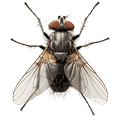
Blow flies (Calliphora vicina, Lucilia spp.)
6-12 mm, metallic blue or green. Strong fliers, fast and noisy. Breed in animal protein — typically arriving with supplier crates from the receiving dock or from spoilage in chiller-temperature failures. Egg-to-adult cycle 9-14 days.
Blow flies are the most visually alarming species for customers and auditors. A single Calliphora bouncing off a fish-counter glass during inspection ends the section's audit score.
Why most stores get this wrong
The default hypermarket fly control program is a UV blue-light trap mounted on the ceiling near the seafood counter, serviced monthly by a generalist PCO. This addresses some adult drosophila and blow flies in the active flight zone but does nothing for:
- Phorid breeding in drain biofilm (drain treatment isn't on the schedule)
- Drosophila source migration from the adjacent produce section (root cause)
- Blow fly arrival via the receiving dock (perimeter / supplier protocol)
- Phorid adults that hide in fluorescent light fixtures and emerge near the floor (UV traps are placed too high)
A fly count target of less than 2 per 30-minute observation in the fish department requires all four pressures addressed simultaneously. Single-tool programs fail.
The integrated HACCP-aligned protocol
What works at a hypermarket seafood counter:
Drain biofilm management (the phorid solution)
- Weekly drain bio-foam application — enzyme-and-microbial blend that digests the protein biofilm phorids breed in. DM-approved formulations available. Apply at 200-300 ml per floor drain, leave overnight, run hot rinse the next morning.
- Quarterly drain inspection — open the drain trap, manual scrape, document biofilm thickness. Photo log into the pest manifest.
- Cost: AED 280-380 monthly for drain program at a 4-counter seafood section.
Source control on adjacent zones (the drosophila solution)
- Produce-section cleanup protocol alignment — push the store's produce and aisle-cleaning schedule into the pest control file. End-of-day deep-clean of produce display zones eliminates 80%+ of drosophila breeding.
- Targeted drosophila monitoring traps at the produce/seafood section boundary. Vinegar-trap design or commercial pheromone trap. AED 120-220 per trap per month.
- Customer-cart hygiene — periodic cart-wash schedule. Often missed, often the biggest residual source.
Supplier control (the blow fly solution)
- Receiving dock fly-monitoring trap — sticky board with attractant, away from food zones. Service weekly.
- Supplier crate inspection protocol — visual check at receiving, reject crates with visible fly activity or evidence of larvae.
- Chiller temperature audit — chillers running above 4°C invite spoilage and blow fly attraction. Daily temperature log integrated with pest log.
Adult capture in the customer zone (the visible-fly solution)
- Glue-board UV trap NOT directly over food display — placement at 2.0-2.5 m height, 3-5 m from the seafood display, NOT in line-of-sight with customers. Yellow-glue base, not the blue-electrocution type — electrocution scatters debris.
- Air curtain at the cold-chain access door — validated quarterly for airflow speed (should be 11+ m/s at door floor level).
- Door-seal inspection on the back-of-house cold room — brush seals on every door, replaced on visible wear.
What the HACCP CCP integration actually looks like
Fly control becomes a Critical Control Point (CCP) in your HACCP plan if your fishmonger counter is a high-risk zone (it is, by default). CCP integration requires:
- Documented critical limit — fly count target, typically <2 per 30-minute observation in the active counter zone.
- Monitoring frequency — daily by the section supervisor, weekly verification by the PCO technician.
- Corrective action plan — what happens if the count exceeds the limit. Typically: stop service of section, conduct deep clean, escalate to pest control for same-day visit.
- Verification record — signed log, with technician ID for any PCO visit, available for auditor inspection.
Dubai Food Safety Department (DFSD) and ADPHC inspectors check this integration during routine inspection. Failure to demonstrate documented CCP monitoring is itself a non-conformance, separate from the underlying fly count.
DM Food Safety inspection rubric
DFSD inspections of hypermarkets follow a published rubric. Pest-control-related findings sit in two categories:
- Critical (major non-conformance) — live fly count exceeding threshold in food preparation/display zone; rodent activity; lack of pest log
- Major (significant non-conformance) — missing documentation, expired PCO contract, unverified PCO license, inadequate monitoring frequency
- Minor — minor record-keeping gaps, single dead fly in non-food zone
A single critical finding in the fish department triggers immediate corrective action plus re-inspection within 14-30 days. Repeat critical findings within 12 months escalate to formal warning, fine, or potential section closure pending corrective demonstration.
DFSD's published fine schedule for unmaintained pest control in F&B operations: AED 5,000-50,000 per substantiated finding.
Cost of a proper program
Real numbers from hypermarket programs we've delivered:
- Large hypermarket, 4-6 seafood counters, full integrated program — AED 2,800-4,200 monthly, AED 33,600-50,400 annually. Includes weekly visits, monthly comprehensive audit, all documentation work, emergency response within 4 hours of call.
- Smaller supermarket with single seafood counter — AED 1,200-1,800 monthly, AED 14,400-21,600 annually.
- Emergency response for failed audit — AED 1,800-2,800 same-day intervention, includes deep drain treatment, source identification, immediate trap reconfiguration.
Compared to a single failed audit's downstream cost (re-audit fees, brand reputation, potential section closure days), the program pays for itself on a single avoided major non-conformance.
What the Carrefour story ended up being
For the store that called us on Thursday: we did a 14-hour first visit covering deep drain treatment under all four cutting stations, repositioned the existing UV traps, added two glue-board trap stations at correct height, added drosophila monitoring at the produce boundary, and ran a supplier-dock fly-count survey. Fly count at the seafood counter at the 14-day re-audit: 1.4 per 30-minute observation. Passed.
Store signed a 36-month integrated contract. The previous PCO's monthly cost was AED 480; the new contract sits at AED 2,400 monthly. Store accounting saw the increase as a hard sell upfront. Six months in, the store reported zero major non-conformances on pest-related items vs an average of 1.4 per year previously, plus reduced product-spoilage rates the store credits partly to the supplier-dock improvements we drove.
Getting started
We service hypermarket and supermarket clients across the UAE — Carrefour, Lulu, Spinneys, Géant, Union Coop, plus independent operators. Book a section audit and we'll quote against the actual pest profile, not a template. More on our commercial pest control and restaurant / F&B pest control for related operations. See also our pest control log book piece on the documentation side.
FAQ
Can we do fly control during trading hours?
Drain treatments, trap servicing, and visual inspection happen during trading hours without disrupting customers. Spray applications, drain deep-cleans, and emergency interventions are scheduled overnight or early morning. We do most hypermarket work in two windows: 22:00-02:00 for back-of-house deep work, and 06:00-09:00 for customer-zone setup.
Will my existing PCO's UV trap stay in place?
UV traps are usable if positioned correctly. We commonly relocate existing units rather than replacing them — cheaper for the client and the equipment is fine. The position is almost always the issue, not the unit.
Does DFSD accept any PCO's records?
DFSD requires the PCO to hold an active Dubai Municipality Pest Control License Category for commercial F&B operations. Confirm the PCO number on the DM portal before signing. We provide our license details on every quote.
What's the difference between phorid and drosophila for an auditor?
Most auditors will record both as "small flying insect" in the count. Internally for diagnosis, the difference matters because the treatment is different — phorids need drain work, drosophila need adjacent-section source control. If you find the count keeps creeping back, the diagnostic step is identifying which species is dominant.
Tags
Written by
Maria Fernandez, Commercial Accounts Lead
PestSwift technicians and entomologists publish field-tested pest control guidance for UAE homes and businesses.