


A JBR terrace, four citations in one summer
The head chef at a JBR shisha-and-grill venue showed me his 2024 inspection log on a Tuesday morning in August. Four DM food safety flags that summer, three of them tagged "fly activity in the dining area." The indoor kitchen was spotless — HACCP-aligned, full pest control schedule, EFK units mapped on the floor plan. The terrace was the entire problem.
His pest control contractor had been treating the indoor side every two weeks. The terrace got a quarterly perimeter spray. That's the model most Dubai F&B venues run, and in summer it doesn't work for outdoor seating. By June, the terrace fly count was a magnitude higher than the kitchen, and DM inspectors don't differentiate when a customer's plate has a blow fly on it.
For venues with significant outdoor service in JBR, JLT, La Mer, City Walk, Bluewaters, or any beach club, the summer story is the same. Indoor fly control is a solved problem. Outdoor terrace control under Dubai summer conditions is not.
What changes between April and July
Fly biology under heat is not a small effect. The common house fly (Musca domestica) at 25°C completes its egg-to-adult cycle in roughly 14 days. At 35°C, that drops to 7 days. At 40°C plus high humidity — Dubai's typical July night — it drops to about 5 days.
This means a single breeding source on or near your terrace can scale from invisible to overwhelming inside a single week. The maths is brutal: one female house fly lays roughly 500 eggs in her short life. At a 5-day cycle, three generations in a fortnight take you from a handful to a swarm.
Three species matter for Dubai outdoor dining specifically:
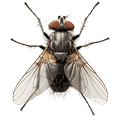
- House fly (Musca domestica). Generalist. Lands on faeces, then on food. The DM inspector's primary concern.
- Blow fly (Calliphora and Lucilia species). Larger, metallic green or blue. Attracted to meat odours — kebab grills, shawarma stations, raw fish in display cases. They lay eggs on exposed protein within minutes.
- Flesh fly (Sarcophaga). Greyish, larger again. Attracted to garbage and decomposing organic matter. Comes in waves from off-site dumpsters and bin yards.
Each has slightly different attractants and slightly different exclusion logic. A general "fly control" plan that doesn't differentiate species is treating an average that doesn't exist.
Why indoor solutions don't translate outdoors
Electric fly killers (EFKs) and UV light traps are the workhorses of indoor fly control. In Dubai outdoor settings, they hit four walls quickly:
- Sunlight outcompetes the UV lamp. EFKs work by being the brightest UV source in the room. In direct sun on a terrace, they're invisible to flies.
- Open air dilutes pheromone-based traps. The active ingredient evaporates and disperses before it builds an attractive plume.
- Air curtains are designed for doorways, not open seating. A terrace has no "door" to seal.
- Residual surface sprays break down faster outdoors. UV exposure halves the effective life of most synthetic pyrethroids in days, not weeks.
This is why a contractor offering the same plan indoors and outdoors is selling you the same product twice and underdelivering on one of them.
What actually works on a Dubai terrace in summer
The approach we use for our F&B clients is layered. No single tactic solves the problem; the layers compound.
Source elimination off-property
We walk a 50m perimeter around the venue with the FM and identify breeding sources. The big ones in JBR and JLT are: shared bin compactor rooms, pet relief areas in the podium, mall-back-of-house dumpsters, and any uncovered drain near the food prep zone. About 70% of summer fly pressure comes from off-property sources within that 50m radius. The bin compactor schedule is usually negotiable; the pet relief area is a longer conversation with the FM.
Wind-zone EFKs (not direct sun)
If you must use UV traps outdoors, place them in the shaded ceiling overhang of the terrace, oriented away from the open sky, so the lamp is the brightest UV source within the immediate canopy. Wall-mounted, not free-standing. Glue-board models, not high-voltage zappers — zappers in food-service zones are a HACCP problem because of the splatter.
Bait stations off-property, not in the dining area
Fly bait stations contain attractant + insecticide, and they belong away from where customers eat. We typically place them on the bin yard fence line, on the kitchen-door exterior wall, and on any wall that faces a known breeding source. They pull flies away from the dining area before they arrive.
Larvicide on standing water
Irrigation drip pans, AC condensate trays, plant pot saucers, and any decorative water feature get a methoprene or Bti larvicide. This kills mosquito larvae too, which is a useful side effect — mosquitoes are the other summer terrace problem.
Daily housekeeping the kitchen team owns
No treatment plan survives a sloppy bin schedule. The terrace bins must be emptied and swapped on a defined schedule (we typically write 90 minutes for outdoor bins in summer, 4 hours indoors). Spilled drinks get cleaned in under 5 minutes. Used napkins don't sit on tables between covers.
What DM and ADFCA actually look for during a terrace inspection
The Dubai Municipality Food Code (current version 2.0) is explicit on outdoor service zones. For practical terrace inspections, the points that get cited most often are:
- Visible fly activity on or near food contact surfaces.
- Bin lids open or missing.
- Standing water in plant pots, drain channels, or condensate trays.
- Lack of physical exclusion (mesh, screens, or air curtains) at the kitchen-to-terrace pass.
- Pest control records that don't include outdoor zones.
The last one is the easiest one to fix and the one most contractors miss. Your pest control documentation must show the terrace as a treated zone with a defined service frequency. If your records only mention the kitchen, the inspector treats the terrace as untreated, even if the contractor was actually doing work there.
Real cost bands for outdoor F&B fly programmes
For a venue with 80–150 outdoor covers in JBR, JLT, City Walk, or similar:
- Summer-intensive monthly plan, May–September: AED 1,800–2,800/month
- Year-round bi-monthly with summer top-ups: AED 1,200–1,800/month average
- One-off remediation after a citation, two-week intensive: AED 3,500–6,500
- HACCP audit prep and documentation review (no treatment): AED 1,500–2,500
The summer-intensive monthly is the model that actually keeps the terrace inspection-clean for venues with significant outdoor service. The bi-monthly works for venues with mostly indoor seating and a small terrace.
For parallel issues in indoor venues, see drain fly control in Dubai food courts and our HACCP pest control playbook for restaurants. Our commercial pest control service page covers the full F&B offering. To set up a terrace audit before the summer fly cycle starts, contact us.
Frequently asked questions
Are EFKs HACCP-approved for outdoor seating in Dubai?
Glue-board UV traps are. High-voltage zappers (the kind that snap when a fly hits) are not, because the splatter risk over food-contact surfaces violates HACCP principles. The EFK type matters more than the location. We replace zappers with glue-board models on first audit for almost every new F&B client.
How often does the terrace need fly treatment in summer?
For most Dubai outdoor venues, every 14 days from May through September. That's enough to catch each generation before it scales. Quarterly is what most contractors quote; quarterly fails on terraces every summer without exception.
Why are flies worse on Friday and Saturday nights?
Peak garbage volume in the bin yard, plus higher exposed-food density on tables. The breeding pressure within 50m of your venue spikes on weekends, and the in-dining-area fly count follows by 24–48 hours. Plan a Sunday-morning extra service if your peak operation is weekends.
Will fly treatment affect my outdoor diners during service?
Not if it's done correctly. All terrace treatments we run on active F&B properties happen between closing and 5am, with full re-aeration before service. Bait stations and larvicide work passively without contact. The only customer-facing element is the EFK, which is silent and out of sightline when placed correctly.
Tags
Written by
Maria Fernandez, Commercial Accounts Lead
PestSwift technicians and entomologists publish field-tested pest control guidance for UAE homes and businesses.