


The 7 PM verandah problem
District One Mansions has a view problem. Specifically, you bought the villa for the lagoon view, the kids' play turf wraps to the water edge, and from late April onward the verandah becomes unusable after 6:45 PM. The dishwasher takes longer to load than dinner outdoors lasts.
This is the MBR City and Meydan villa mosquito story. Not because anyone built badly. Because the same ornamental water that makes these communities premium also stacks more Aedes albopictus breeding surface area into a single villa plot than entire neighbourhoods.
The fix exists. It's a six-week pre-summer protocol with monthly maintenance through the warm months. Done right, it pushes the unusable-evening window back by two hours and reduces bite count by 80–90%. Done badly — and most of what we see being sold here is done badly — it gives one good week, then nothing.
Three water sources, three different problems
MBR City and Meydan villas typically have:
- The community Crystal Lagoon edge — at District One that's an 8.4 km swimmable lagoon. At MBR City Phase 1 villas it's smaller ornamental ponds and waterways.
- Private pool — almost universal, often with separate kiddie pool.
- Landscape water features — ornamental fountains in the entry court, rill water along garden walls, decorative basin features.
Each attracts a different mosquito and needs a different treatment.
Crystal Lagoon edge
The big lagoon is chlorinated and filtered — adult-mosquito-hostile. But the edge zone where shoreline plants meet water, irrigation overflow, and bird-bath effects in landscape rocks creates micro-pools that the lagoon's filtration doesn't reach. Those are Aedes nurseries.
We survey the entire edge of the villa's lagoon frontage monthly during the warm season. Anywhere standing water sits for more than 4 days gets a Bacillus thuringiensis israelensis (Bti) tablet — a biological larvicide that's lethal to mosquito larvae and harmless to fish, birds and mammals. Dosage is 1 tablet per square metre of standing water, reapplied every 30 days.
Private pool
A running, chlorinated pool isn't the problem. The pool surround is. Specifically:
- Pool cover wells where rainwater sits for weeks before evaporating
- Filter backwash basin
- Pool deck drains with slow drainage
- The plant saucers around pool-adjacent landscaping
- Inflatable pool toys left out, accumulating dew
These hold 200–500 ml of water for 7–14 days — enough for a full Aedes life cycle (egg to adult in 7–10 days at 28–32°C). We empty, treat, or modify each.
Landscape water features
Decorative fountains, ornamental basins, water-wall features. Most have small pumps that turn off overnight. The standing water during pump-off hours is enough to support breeding.
Fix: either run the pump 24/7 (cheap in MBR City's grid; about AED 35–60/month on electricity for a typical feature pump) or treat with IGR (S-methoprene) tablets every 30 days. We also add a screened cover to ornamental basins to deter egg-laying. Bird-of-paradise plants and tall water-iris around feature edges hide perfect breeding pockets — we trim back to maintain inspection access.
The pre-summer six-week ramp
If you start in early May, by mid-June you're in shape. If you wait until the first bite, you're chasing.
Week 1: Property survey — full walk of the villa, lagoon frontage, all water features. We map every standing-water source onto a property diagram. This becomes the treatment plan.
Week 2: Source elimination — drain or modify what doesn't need to exist. Empty pot saucers. Re-grade pool deck drains. Cover the kiddie-pool inflatable when not in use. Re-route the irrigation drip on the entry-court flower bed so it doesn't pool.
Week 3: Larvicide application — Bti tablets in every remaining water surface. IGR in the ornamental fountain basin. Detailed log of placements.
Week 4: Perimeter residual + landscape ULV — Deltamethrin suspension concentrate spray on landscaping foliage where adult resting sites concentrate (under-hedge, dense shrub interior, palm fronds). ULV (ultra-low-volume) fogging of the garden landscape using Pyrethrin + PBO synergist mix at first-light or dusk — when Aedes are active and pollinators are not.
Week 5: Re-survey — count adult mosquitoes at three garden positions for 10 minutes each, evening. Compare to week 1 baseline.
Week 6: Monitor and dial-in — adjust larvicide schedule based on what the survey showed. Programme stable by week 6 for the rest of summer.
From there, monthly maintenance through October. Each visit: re-check larvicide tablets, residual touch-up, ULV fog if numbers creep.
What it actually costs
For an MBR City or Meydan villa, real numbers from PestSwift jobs in 2024 and 2025:
| Villa profile | Setup (weeks 1–6) | Monthly maintenance May–Oct |
|---|---|---|
| 4-BR villa, no lagoon frontage, private pool | AED 1,800–2,400 | AED 450–650 |
| 5-BR villa, 1 water feature, pool | AED 2,400–3,200 | AED 600–850 |
| 6-BR District One mansion, lagoon frontage, multiple water features | AED 3,800–5,800 | AED 900–1,400 |
Lagoon frontage is the biggest variable. If you have 20+ metres of edge, monthly survey time is real. We price honestly — no per-tablet bill at the end.
For a comparison against villa garden fogging costs in less complex communities, see garden mosquito fogging cost in UAE villas.
What Dubai Municipality is doing in the background
DM installed 237 smart mosquito traps across the emirate as of early 2025, with data integration to inform community-level fogging schedules. MBR City and Meydan are covered. The trap data feeds an early-warning system DM uses to deploy public ULV fogging in adjacent road corridors.
That's helpful baseline pressure reduction, not a substitute for villa-level treatment. Public fogging hits the road verge and major landscape strips. It doesn't enter your plot.
An aside: if you see a DM fogging truck overnight, that's why your bite count drops for 48 hours. The villa-level treatment is what maintains the reduction past that.
Species worth knowing about
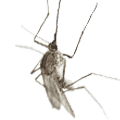
The villa biter in MBR City is overwhelmingly Aedes albopictus — the Asian tiger mosquito. Daytime biter, distinctive black-and-white legs, peaks at dawn and dusk. It transmits dengue, chikungunya, and Zika regionally. There has been no large local dengue outbreak in Dubai, but ADPHC reported elevated dengue case counts in Abu Dhabi residential clusters during the 2024 summer, prompting tighter mosquito-control mandates on residential properties with stagnant water. Dubai municipalities follow patterns and the regulatory direction is clearer year on year.
The lagoon edge sometimes adds Culex pipiens (the common house mosquito) which is more dawn/dusk and tends to bite at lower volume but transmits West Nile and lymphatic filariasis. Different breeding profile (organic-loaded standing water vs Aedes's clean small containers).
If you want more on the prevention side, pre-summer mosquito Aedes source removal in UAE covers the source-removal logic in detail.
What gets done badly
The two patterns that fail in MBR City:
Pattern one: fog-only programmes. A contractor shows up monthly, fogs the garden, leaves. Adults die. Larvae in your unfound water source mature to replace them within a week. By week three, you're back to pre-treatment numbers.
Pattern two: indoor-only treatment. Plug-in vaporisers, indoor residual sprays, mosquito traps inside the villa. These reduce indoor bite, sometimes. They do nothing about the verandah, the BBQ area, the pool deck. Outdoor pressure stays.
The protocol that holds is source elimination + larvicide + selective adult-control fogging + monthly re-survey. Order matters. Most failures are skipping step one or two.
FAQ
Are larvicides safe for the lagoon and pool?
Bti is a naturally occurring bacterium specific to mosquito and blackfly larvae. It's safe for fish, birds, dogs, swimmers, and reef life. EPA-classified as a biological pesticide. We don't apply it inside chlorinated pool water — that's already hostile to larvae. We apply it to peripheral standing-water pockets the pool's filtration doesn't reach.
How quickly will I see results?
Adult mosquito numbers drop sharply within 48 hours of ULV fogging. But the larvae already developing will mature over 7–10 days. By day 14 you should see a sustained 70–80% reduction. Week-3 onward is when the bite count drops to background.
Do I need to do anything between monthly visits?
Empty any standing water you create — pot saucers, kids' pools after use, BBQ catering tubs. Don't wash off the residual perimeter spray during the first 5 days. Tell us if you see a sudden uptick — that usually means a new water source we didn't catch.
Can the gardener interfere with treatment?
Yes, accidentally. Over-irrigation washes residual spray. Pruning landscape that we marked as adult-resting zones removes the targeted treatment area. We share the property map with your gardener — most are cooperative once they see the logic.
Get your evenings back
If your verandah's been off-limits since April and the current monthly fogging isn't holding, we can audit your property and propose a six-week ramp with monthly maintenance from May through October. Get a free MBR City or Meydan villa quote, or read our full mosquito control service.
Tags
Written by
Rashid Al Mansoori, Operations Manager
PestSwift technicians and entomologists publish field-tested pest control guidance for UAE homes and businesses.