
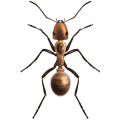
A Whispering Pines kitchen with three trail systems
The homeowner had been spraying with a supermarket aerosol for six weeks. Every morning new trails. The technician arrived expecting standard ghost ants and instead found three coexisting trail systems — pharaoh, ghost, and a smaller dark Tetramorium species — all running between the dishwasher cavity and the back patio door at the same time.
This is what golf-course-edge villa kitchens look like when the spray-everything reflex meets Monomorium pharaonis biology. Spraying pharaoh ant trails causes the colony to bud — workers and a queen split off and start a new sub-colony nearby. So your one ant problem becomes three problems. The Whispering Pines kitchen had budded twice in six weeks.
We pulled all aerosol residue with a degreaser, placed indoxacarb gel-bait at six trail-intercept points, and left. Trails were down 80% by day 4 and gone by day 11. No spraying.
Why Jumeirah Golf Estates ants are their own challenge
JGE has three biology drivers that other Dubai villa clusters don't share at the same intensity.
Continuous golf-course irrigation. The Earth Course and Fire Course irrigate in defined cycles, typically pre-dawn and again late afternoon during summer. Soil moisture along the course-villa border stays consistently higher than surrounding desert plots. Higher moisture supports larger and longer-lived ant colonies, particularly Pheidole megacephala (big-headed ant) and Tapinoma melanocephalum (ghost ant).
Manicured turf-and-flower-bed transitions. The Earl Grey, Flame Tree, and Whispering Pines villa rows have turf-to-flowerbed-to-paving transitions every few metres. Each transition creates a thermal and moisture gradient that ant scouts read as a foraging boundary. Trails follow these gradients almost perfectly.
Structural-pest accommodating villa design. Most JGE villas have stone-clad exterior walls, paving stone garden paths, and wood-detail kitchen units. The mortar joints, paving voids, and cabinet hinges are all classic ant-harbourage substrates.
We cover the broader ant-on-villa angle in ant control Dubai Hills Estate villa — the species mix is similar but Dubai Hills lacks the consistent golf-course irrigation pressure.
Identifying which ant you actually have
A reflexive aerosol works on the wrong species. Diagnostic identification matters because the treatment protocol differs.
Pharaoh ant (Monomorium pharaonis) — yellowish-light-brown, very small (2 mm), trails that scatter when disturbed. Multi-queen colonies that bud aggressively when sprayed. Treatment: gel-bait only, never spray. Indoxacarb 0.05% or hydramethylnon 1% gel.
Ghost ant (Tapinoma melanocephalum) — pale translucent body with a dark head and abdomen, 1.5 mm. Soft musty smell when crushed. Lives in plant stems, behind wallpaper, in kitchen cabinet voids. Treatment: gel-bait first, perimeter dust second. Boric acid sweet bait works on this species particularly well.
Big-headed ant (Pheidole megacephala) — two distinct worker sizes, the larger "soldier" with an oversized head. Brown, 3-4 mm. Aggressive mound builder in JGE flowerbeds. Treatment: granular bait (orthoboric acid 5% + soybean oil) at mound openings.
*Pavement ant (Tetramorium spp.)* — dark brown to black, 3 mm. Lives under paving stones and along grout joints. Treatment: protein-based gel-bait or, where the colony is contained to a single paving zone, drench treatment.
If you photograph the ant and send it with your enquiry, we identify before we arrive. This shaves 20 minutes off the first visit.
We go deeper on multi-queen species in pharaoh ants Dubai apartment budding.
The irrigation-cycle activity timing
Pattern recognition from running JGE jobs across multiple seasons:
- Pre-irrigation (early evening, typically 16:00-17:30 in summer): scouts active above ground, looking for water and food at villa edge
- During irrigation: activity drops 60-80%, ants retreat into colony
- 2-4 hours post-irrigation: activity peak, foraging trails fully formed and visible
- Late night (22:00 onward): activity drops again as soil cools
This matters because gel-bait works best when foragers are active and hungry. We schedule bait placement so the first 2-3 hours after placement coincide with the post-irrigation peak. That maximises uptake.
It also matters because it tells you when not to use a spray-and-walk-away approach. The cheap weekend-DIY of spraying after dinner kills the visible foragers but misses the colony entirely.
What we charge
For a typical JGE 4-5 BHK villa with garden, kitchen activity, and exterior trail evidence:
- Single-visit assessment + treatment (gel-bait + perimeter): AED 380-480
- Three-visit program over 8 weeks (handles budding species): AED 580-820
- Quarterly maintenance program (after initial knockdown): AED 320-420 per visit
- Annual program covering ant + general crawling-insect prevention: AED 1,800-2,400
The three-visit program is what most pharaoh-ant cases need. Single visits don't reach all the budded sub-colonies; the second and third visits target the new ones that emerge as the original colony collapses.
Why we don't spray (in JGE specifically)
Three reasons, in order of importance:
- Pharaoh budding. Already explained. Spraying multiplies the problem.
- Course-edge wildlife. JGE has nesting birds (notably hoopoes and white-eared bulbul), garden geckos, and active honeybee foraging from nearby municipal hives. Pyrethroid spray drift affects all three. Gel-bait is target-specific.
- Resident pet density. JGE villas average more pets per household than most Dubai clusters. Indoor cats and dogs walking through fresh spray residue is a known route for low-grade chronic pyrethroid exposure. Gel-bait, placed in cabinet voids and behind kickboards, is inaccessible to pets.
There is a place for perimeter spray on JGE jobs — the exterior garden boundary, applied as a crack-and-crevice treatment on paving joints away from foliage. It's a supplementary tool, not the primary one.
Garden-side things you can do
Three changes around the garden noticeably reduce ant pressure between visits:
- Move the bin store away from the kitchen door. A garden bin within 4 m of a door is a foraging source. 8 m or more is much better.
- Patch grout cracks in the patio paving. Pavement ants and Tetramorium nest in the substrate beneath. Re-grouting a 4 sqm patio area is a weekend job and removes a major harbourage.
- Trim flowerbed irrigation drip-tubes back from the villa exterior wall. Drip-tube touching wall = direct moisture path = ant highway. Keep a 30 cm gap.
None of these prevent ants. They reduce the recruitment rate so re-treat windows stretch longer.
FAQ
Why does my house have a constant ant problem when my neighbour says they don't?
Microclimate. Two adjacent JGE villas can have very different ant pressure based on which side faces the prevailing wind, whether the garden has bromeliad-style plants holding water, where the irrigation manifold sits relative to the kitchen, and whether the bin store is within 4 m of the door. We map these on the first visit.
Will gel-bait stay safe with my dog walking around?
Yes if applied correctly. We place gel-bait in cabinet hinge cavities, behind kickboards, inside electrical-box wall voids, and on the underside of patio plinths. None of these are dog-accessible. The total active-ingredient quantity per villa is under 3 grams of formulated gel, and the active is diluted within that gel — far below any acute exposure threshold.
How long after treatment should I see results?
With gel-bait, peak ant activity often increases in the first 24-48 hours as more workers come to feed at the bait stations. That looks alarming and it isn't. Activity then drops sharply over days 3-7 as the active reaches the queen. By day 10-14 trails should be gone or very sparse. Day 21+ is the verification point. If you still see trails at day 21, contact us and we re-bait under the included follow-up.
Can you treat both my villa and a neighbour's at the same time?
Yes — and for budded pharaoh ant cases involving an adjacent villa border, we recommend it. We discount the second villa by 20% on a same-day pairing. Coordinate with your neighbour and book together.
Book a JGE assessment
If you're in Earl Grey, Flame Tree, Whispering Pines, Lime Tree, or any of the JGE villa clusters and have ant trails inside the villa or visible exterior activity, contact us. For broader service context, see our ant control service page. The first visit is an assessment plus initial treatment — by the time we leave, the colony is already beginning to take down the bait.
Tags
Written by
Dr. Karim El-Sayed, Lead Entomologist
PestSwift technicians and entomologists publish field-tested pest control guidance for UAE homes and businesses.