

Look. The Ajman Corniche bed bug problem is structurally different from the Dubai Marina version of the same problem, and pretending otherwise is why most generic UAE pest control writeups give such useless advice.
In Dubai Marina, holiday lets run on DTCM permits, professional operators, full-time linen contracts. In Ajman, the corniche tower stock cycles weekend after weekend through Airbnb listings that nobody is auditing. The same flat sees a different family every three nights from October through March, and a steady stream of weekenders escaping the Dubai rent the rest of the year. The cleaner has forty-five minutes between checkouts. There is no laundry contract. The mattress encasement is the same one that was put on in 2021 and has a torn corner.
That is where the bed bugs come from. Not from the building. From the rotation.
What the Ajman Corniche stock actually looks like
The relevant tower belt runs from the Sheraton Ajman Beach Resort end of the corniche down through the Al Rumaila corniche-front towers and the inland blocks of Al Nuaimia 3. Most of it was built between 2007 and 2018. The towers are mid-rise (12 to 30 floors), with one to three-bedroom flats, sea views on the Al Rumaila side and city views on the Al Nuaimia side.
A significant portion — informally something like 30 to 50 percent of the corniche-front tower units we've worked in — function as short-stay rentals. Some are on Airbnb, some on Booking, some informal Facebook groups, some just word of mouth among Dubai weekenders who want a beach trip without the Dubai room rate.
This is not a value judgement. It's just the operational context that drives the pest pattern.
The weekend import vector
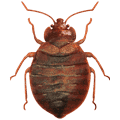
A bed bug adult lives roughly 4 to 6 months under typical UAE indoor conditions. A female lays 1 to 5 eggs per day across her adult life, totalling 200 to 500 eggs. Eggs hatch in 6 to 10 days at corniche-tower ambient temperatures and humidity. Nymphs reach reproductive maturity in 5 to 6 weeks.
Given that, a single mated female arriving in a guest's suitcase in March can produce a detectable nymph population in the same flat by mid-April, and a generalized infestation by late May.
When the rotation churns weekly guests through that flat across the same period, three things happen:
- Cross-pollination between flats. A guest leaves with a few hitchhikers in their weekend bag, takes them to a different flat the next month, and the bed bug spreads horizontally across the building's short-stay inventory.
- The cleaner doesn't see it. Forty-five minutes is enough time to strip and remake the bed, not enough to inspect the bed frame joints or curtain hems.
- The owner is usually offsite. Many corniche-front units are owned by long-distance investors who get told about the bites only when a guest leaves a one-star review. By then the population is fully established.
It is not a property condition issue. It is a turnover-management issue, and the only way to actually clear it is to coordinate treatment across the operator, the cleaner, and the building.
Why Ajman is different from Dubai and Sharjah
Three practical things differ.
First, jurisdiction. Ajman Municipality (Department of Public Health) licenses pest contractors, not Dubai Municipality and not Sharjah Municipality. A Dubai-licensed crew operating in Ajman without an Ajman registration is technically not compliant, and a number of small Dubai-side operators do exactly that. Ask for the Ajman registration number.
Second, beach humidity. The corniche-front building stock sits 100 to 300 metres from the sea. Indoor humidity on those flats runs noticeably higher than equivalent Dubai or AD inland towers — typically 55 to 70 percent vs 40 to 55 percent. Higher humidity extends bed bug egg viability between treatment cycles, which is the main reason why a 14-day follow-up in Ajman is not negotiable (in lower-humidity environments you can sometimes push to 21 days).
Third, building-side fragmentation. Ajman building OAs (where they exist at all) have less authority than their Dubai or Sharjah counterparts to require coordinated building-wide pest action. If three adjacent flats are infested and only one owner pays for treatment, the other two re-seed within a month.
The protocol that works for Ajman Corniche towers
Inspection
We budget 45 to 60 minutes for a typical 1-BR corniche-front flat. Two technicians work in parallel — one on the bedroom, one on the living area where the convertible sofa-bed adds another harborage. We check:
- Bed frame head-to-side-rail joint cavities, including the metal corner brackets
- Mattress piping seams, both faces, head and foot
- Mattress encasement integrity (a torn corner makes the encasement useless)
- Bed-side wall to skirting board crevice
- Curtain hems within one metre of the bed
- The convertible sofa-bed mechanism cavity — the single most under-checked harborage in a holiday-let flat
- Wardrobe back corners, bedside table drawer-pull cavities, bedside lamp base
Treatment
We combine heat and chemical. Heat for the bed itself and the sofa-bed mechanism (50°C sustained for 90 minutes inside a portable heat tent — we don't tent the whole flat, just the affected furniture, which keeps cost manageable). Chemical residual (chlorfenapyr 5SC) along the wall-floor crevice and behind skirting boards.
For a flat that already has documented activity in two or more rooms, full-flat heat treatment makes more sense — single-room heat work in a flat with open circulation lets surviving adults migrate during the treatment.
Diatomaceous earth dust into the wall-socket plate cavities along the headboard wall. The wall-socket cavity is a classic Ajman corniche tower hiding spot because the building electrics use deeper junction boxes than typical Dubai towers, leaving more void.
Follow-up
Return at 14 days. Visual re-inspection, CO2 lure trap for the following 48 hours, photographic record. If clean, the flat is signed off. If activity is detected, a targeted re-treatment of any specific harborage found, with another 14-day follow-up. No flat is closed out until two consecutive 14-day inspections come back clean.
For an actively rented flat we coordinate with the operator to block bookings for 21 days from first treatment — heat treatment day, 14-day follow-up, plus the 48-hour CO2 trap. This is non-negotiable for a serious result. Operators who want to skip the blocked-booking window get a different vendor.
Cost
A standard 1-BR Ajman corniche-front flat treatment, including inspection, targeted heat treatment of the bedroom suite and convertible sofa-bed, chemical residual perimeter, dust treatment, and the 14-day follow-up, runs AED 450 to 900. A 2-BR runs AED 700 to 1,400. A full-flat-tent heat treatment for severe multi-room infestations runs AED 1,200 to 2,400.
The Ajman rates sit roughly 20% below the equivalent Dubai figures. The difference is labour cost, not protocol — we use the same equipment, the same chemistry, and the same trained technicians.
For short-stay operators running 8 or more units on the corniche, an annual maintenance contract with quarterly preventive inspections plus emergency callout typically runs AED 4,500 to 12,000 per year depending on inventory size. That arrangement usually pays for itself in one prevented multi-room infestation.
What does not work
Over-the-counter sprays from a UAE hypermarket. The active ingredients are typically permethrin or deltamethrin at consumer dilution; bed bugs in this region are widely resistant to pyrethroids and the spray simply scatters them.
Swapping the mattress without treating the structure. The mattress is sometimes the most visible harborage but rarely the only one. A new mattress lasted on a flat with active wall-cavity harborage shows live activity again in 4 to 8 weeks.
Relying on the cleaner. The cleaner does not have time or training to inspect for bed bugs between guests. Asking them to is unfair and unproductive.
Using a Dubai-licensed contractor without Ajman registration. Beyond the compliance issue, the practical implication is that the contractor cannot legally file a treatment certificate that the Ajman OA will accept for building-wide coordination.
FAQ
Does Ajman Municipality require licensed pest control for bed bug treatment?
Yes. Pest control work in Ajman residential property must be performed by an Ajman Municipality Department of Public Health licensed contractor with technician permits. Treatment certificates from a non-Ajman-licensed contractor are not accepted for OA documentation or for tenancy dispute purposes. Always ask for the Ajman registration number before booking.
How do bed bugs spread between Ajman Corniche holiday-let apartments?
Primarily via guest baggage. A guest staying in an infested flat picks up adults or eggs in their suitcase or laundry bag, takes them to the next flat they stay in (in the same building or elsewhere), and the cycle starts over. Secondarily via shared building infrastructure — particularly through the gap between the wall-socket plate and the junction box, which connects to the next flat's electrical riser. The guest-baggage vector is far more common.
What is the cheapest Ajman bed bug treatment that actually works?
For a single-room small infestation caught early, the targeted heat-tent-plus-chemical-residual approach at AED 450 to 700 is the minimum-cost treatment that has a high success rate. Below that price point you are typically getting chemical-spray-only, which has high failure rates against modern UAE bed bug populations. The cheapest treatment that works is the one done once, properly, with the 14-day follow-up included.
Should the landlord or the tenant pay for bed bug treatment in Ajman?
Under Ajman tenancy practice, the answer depends on causation. Building-structural causation (shared wall, shared riser) is usually the landlord's responsibility. Tenant-introduced infestations (luggage, visitors, second-hand furniture) are usually the tenant's. For holiday-let inventory, the operator and unit owner typically agree this in advance — the cleaner contract is the place to specify which party covers what. Our tenant landlord pest control responsibility UAE guide goes into the framework in detail.
If you're seeing bites after a corniche weekend, or you run short-stay inventory on the Ajman Corniche and you want to get ahead of the next round, request a free inspection. For related Ajman pest patterns, see our bed bug treatment Al Rashidiya Ajman apartment and cockroach control Al Nuaimiya Ajman guides.
Tags
Written by
Rashid Al Mansoori, Operations Manager
PestSwift technicians and entomologists publish field-tested pest control guidance for UAE homes and businesses.