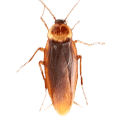




Honestly, Al Reef is one of the cleaner suburban villa communities in Abu Dhabi. The build quality is decent, the streets are wide, the back gardens are real gardens. So when a resident in the Arabian Quarter called us about cockroaches she could hear at night inside her kitchen wall, my first thought was that her neighbour was the source. I was right about the neighbour. I was wrong about which one.
It turned out to be the villa attached on the carport side, two doors down from where she'd been pointing. The colony had spread along the shared carport party wall, into her kitchen via the gas-meter penetration, and what she was hearing was the third generation of German cockroaches established in her wall void. Her direct neighbour was fine. The colony had skipped two villas to get to her because the carport wall was the highway.
This is the pattern we see in Al Reef. The villas look detached. They mostly aren't.
Al Reef's Four Quarters Aren't As Independent As They Look
Al Reef sits south of Yas Island, off the E11 highway. The villa portion is divided into four themed quarters — Arabian, Mediterranean, Contemporary, Desert — built by Manazel between roughly 2008 and 2013. The downtown apartment cluster is separate and has its own dynamics that I'll come back to.
From the street, every Al Reef villa looks like a standalone unit with its own garden. The aesthetic is consistent: hipped roofs in the Arabian quarter, low parapet walls in the Contemporary, terracotta tile and arches in the Mediterranean. What's not obvious from the street is that the villas in each row share a continuous carport party wall on one side. Some clusters share the back boundary wall too, but the carport wall is the consistent shared element.
That wall has a gas-meter recess on each villa side. The recesses sit in the same wall void. The void isn't sealed between units. We've borescoped roughly 30 of these party walls during cockroach investigations. In 24 of them, the void was open along its full length.
For a German cockroach colony, that void is a 30-metre warm tunnel with access points in three or four villas at once.
How a Cluster Outbreak Travels
A single colony establishes in one villa — typically the one with the AC drip pan leaking, or the kitchen with the dishwasher cavity that's a few millimetres off-spec on the rear seal. The colony grows. By the time the resident notices, there are typically 800 to 1,500 individuals across all life stages, mostly hidden in the gas-meter wall void and the kitchen plinth.
Under local foraging pressure, scouts travel outward along the party wall void. They find the next villa's gas-meter recess. If that villa has any food access — a pet bowl left out, a fruit tree shedding fallen figs against the wall, a poorly sealed bin store — they establish a satellite. Then they continue.
Within 8 to 14 weeks, you can have a single colony with breeding satellites in four to six adjacent villas. The original villa's residents may not see the heaviest activity because the colony is spreading outward faster than it's repopulating internally.
This is why a single-villa treatment in Al Reef often "works" for six weeks and then fails. The treated villa was cleared; the satellites in neighbouring villas re-colonised through the same party wall void.
What a Single-Villa Treatment Can Actually Fix
A correctly executed single-villa job stops the within-villa colony and slows re-invasion, but it doesn't kill the satellite colonies next door. We're transparent with residents about this from the inspection visit.
What we do in a single-villa job:
- Pull kitchen plinth, dishwasher cavity, fridge cavity, under-sink unit
- Gel-bait (hydramethylnon or imidacloprid) into all 30 to 50 harborage points
- IGR (pyriproxyfen) injection into the gas-meter wall void through the existing penetration
- Treat the party wall void from both visible ends if possible
- Treat the under-stair void if it accesses a shared chase
- Two follow-up visits at day 14 and day 30
For an Al Reef 4-bedroom villa, this runs:
- 3-bedroom Mediterranean or Arabian: AED 350 to 450
- 4-bedroom Contemporary or Desert: AED 400 to 550
- 5-bedroom plus maid's annex: AED 500 to 650
All prices include three visits and a 60-day re-treatment guarantee on the treated villa only.
When a Quarterly Compound Contract Makes More Sense
If you're in a row of four to eight Al Reef villas and at least two of you have had cockroach problems in the last 12 months, an OA-level or coordinated multi-villa contract is dramatically more cost-effective than each villa fighting independently.
A quarterly compound contract for a six-villa row typically runs AED 1,200 to AED 1,800 per villa per year, all inclusive: four visits per year, party wall void IGR treatment, exterior perimeter spray, year-end documentation pack for the OA file. That's actually less than a single villa paying for three reactive treatments in the same year.
The maths: a typical reactive single-villa job per year (visible problem, treatment, re-emergence, second treatment, second re-emergence, third treatment) costs the same villa roughly AED 1,200 to AED 1,500. The compound contract gets the same villa AED 1,200 but also keeps the four neighbours clear, which keeps your villa clear. We have ten of these running across Al Reef now. The pattern is consistent: the villas with a contract don't re-emerge.
Our annual pest control contract cost UAE post breaks down the contract math for residential villas in more detail. For Khalifa City and Mussafah the geometry is different — those areas have their own carport and shared-wall problems.
Tadweer-Approved Is the Baseline, Not the Differentiator
In Abu Dhabi, any pest control company servicing residential properties must be licensed by Tadweer Group (formerly the Center of Waste Management Abu Dhabi). The licence covers the company, its technicians, the chemicals used, and the waste disposal flow for empty pesticide containers.
Every legitimate Al Reef contractor will mention Tadweer approval. So will many of the questionable ones — the approval is the floor, not the ceiling. What matters more is:
- Is the technician on site holding a personal Tadweer pest control card (they should show it without being asked)?
- Is the chemical container labelled with the registration number and not a generic decanted bottle?
- Does the report include the chemical lot number, application rate, and inspector signature?
If those three things are present, the company is operating compliantly. If they're not, the AED 99 "Tadweer-approved" offer you saw on Instagram is using the approval as a marketing line without actually meeting the standard.
For the regulation context across both emirates, our Tadweer DM compared post lays out the differences in detail.
What's Different in the Al Reef Downtown Apartments
The downtown apartment cluster — the mid-rise blocks closer to the highway — is a completely different problem. The party wall issue doesn't apply because the units are stacked vertically, not horizontally. The cockroach pathway in those blocks is more like a JLT or International City pattern: shared kitchen risers, gas chase, and a podium-level chiller condensate trunk.
If you're in the downtown apartments, the cockroach control in similar cluster apartments blog covers more of what you'll be dealing with, although the build era is closer to Liwan than IC.
What Residents Can Do Between Visits
- Seal the gas-meter recess interior gap. Use copper wool plus silicone. Don't use foam — German cockroaches chew through expanding foam in days.
- Drain and dry the AC indoor unit drip tray weekly. It's free water and warm.
- Move stored boxes off the floor in the garage. Anything sitting against the carport party wall gives them cover to harbour without entering the kitchen.
- Don't drop pet food. A bowl of dry kibble outside the kitchen door is a colony feeder. Lift and clean at night.
- Check the bin store door seal. Most Al Reef bin stores have a 6mm gap at the threshold. Door seal strip is AED 25 at Ace Hardware.
FAQ
My direct neighbour says they don't have cockroaches. Why am I still seeing them?
The colony may be two or three villas away, travelling along the party wall void. We've traced infestations across four consecutive villas where only the end-most resident was complaining. A coordinated row treatment is the only durable fix.
Is the cockroach problem worse in one Al Reef quarter than another?
We see slightly more activity in the Arabian and Mediterranean quarters, mostly because the gas-meter recess detail in those quarters is a fraction of a centimetre more open than in the Contemporary blocks. The Desert quarter has the cleanest detail and the fewest call-outs.
Does the OA have any responsibility for cockroach control across a row?
Not under the standard Al Reef OA covenants. The villa interior and the carport are the homeowner's responsibility. The OA covers community landscaping pest control. That's why coordinated multi-villa contracts work as a workaround — the residents bypass the OA limitation by pooling individually.
Can a Tadweer-approved gel bait product hurt pets or children?
The baits we use have very low mammalian toxicity at the application doses. They're deposited as pea-sized droplets inside cabinet voids and behind appliances where children can't reach. Dogs and cats lick exposed bait only in vanishingly rare cases; the dose required to harm a 5kg pet is roughly 100 times what's deposited in a typical kitchen treatment.
If you're seeing cockroaches in your Al Reef villa, or your row has a recurring problem nobody has properly traced, contact PestSwift for a row-level inspection. We'll map the party wall pathway and tell you whether your villa needs a single treatment or whether you and your neighbours should coordinate.
Tags
Written by
Rashid Al Mansoori, Operations Manager
PestSwift technicians and entomologists publish field-tested pest control guidance for UAE homes and businesses.