
A Sahara cluster owner called us in February. Pristine villa, 14 months old, kitchen handed over with the dishwasher pre-installed by the developer. Three weeks after move-in, German cockroaches were running the under-sink cabinet at night. Owner had already paid two different PCOs for spray treatments. Both killed visible insects for ten days, then the problem returned. We ran a survey of the four adjoining units in his cluster. Two had active infestations the owners hadn't reported. One was actually empty and being used by short-term Airbnb guests.
That's the Damac Hills 2 cockroach problem in a sentence. The chemistry isn't the issue. The cluster is.
What a DH2 cluster actually looks like underneath
Damac Hills 2 (originally Akoya Oxygen, rebranded 2020) was built on a master-plan that put 4-bedroom townhouses and cluster villas in continuous rows of 6-8 units. Walk down the street and you see what look like individual villas with private gardens. Underneath, the foundation slab is poured as a single continuous pour across the full row, with control joints between units rather than full structural separation.
That construction approach saves money and accelerates the build. It also creates a continuous void network underneath. Plumbing chases, electrical conduits and the under-kitchen drain runs all share a single trench system within the slab. The MEP rough-in was done before the unit divisions were finalised, so the actual penetrations between units (where pipes cross the party-wall line) were never properly sealed.
From a German cockroach's perspective, your villa and the next four villas are one continuous habitat connected by 15-25 mm gaps along the under-cabinet kickboard and through the dishwasher drain tail.
Why your single-unit treatment died inside six weeks
Gel-bait works because foraging cockroaches carry the active ingredient back to harborage and the colony eats its dead. That cascade requires the harborage to be inside your treatment zone. If half the harborage is in your neighbour's kitchen — which the cockroaches reach in twelve minutes through the under-cabinet path — your gel bait kills the foragers but never reaches the breeding population.
This is why your spray-and-pray PCO showed you dead bugs the morning after the treatment. They killed everything that was crossing the kitchen surface. The breeding females stayed under the neighbour's kickboard, laid more egg cases, and six weeks later their offspring were back at your dishwasher.
The pattern we see in DH2:
- Day 1-3 post-treatment: Dramatic drop in sightings. Owner thinks problem solved.
- Day 4-21: Zero or near-zero sightings. Owner relieved.
- Day 22-40: Sightings return. Single bugs at first.
- Day 41-60: Population back to baseline. Some clusters worse, because the survivors are the resistant ones.
We've tracked this pattern across 86 single-unit DH2 jobs we've done in the last 18 months. The reinfection median is 47 days.
Handover-phase defects that make it worse
DH2 was a fast-build, large-volume handover wave. Developer QA caught the big structural issues but missed the small ones that matter for pest pressure:
- Kitchen extractor fans rough-installed with 8-15 mm clearance around the duct, sealed with silicone that cracks after 8-12 months. Direct void access into the chase.
- Maid kitchens with under-slab plumbing chases unsealed at the MEP rough-in line. The maid bathroom drain feeds into the same chase as the main kitchen.
- AC plenum runs through the cluster's shared roof void in some Sahara and Akoya phases. Cockroach population can move between units via the AC duct chase if there's a population source in the void.
- Garbage chute access doors on cluster ends with worn rubber seals — a single building-level harborage that feeds the whole row.
None of these are dealbreakers if the units are pest-free at handover. But once one unit gets a German cockroach foothold, the construction-grade gaps become highways.
The cluster-aware treatment protocol
What actually works:
- Inspect the full cluster first. Knock on the four adjoining doors and ask if they've seen cockroaches. Most owners will admit it if asked directly. Two of every four DH2 clusters we survey have at least one active infestation the owner hasn't called about.
- Coordinate the treatment date. All units that want treatment get done the same day or within a 48-hour window. We've found that single-unit treatments fail at the rate quoted above; coordinated 4-unit treatments hold for 8-14 months baseline.
- Treat the shared infrastructure. The under-cabinet kickboard gap gets sealed with an expanding foam + intumescent compound applied to all units. Drain traps get IGR (pyriproxyfen) treatment to break the breeding cycle in any biofilm.
- Apply gel bait at 8-12 placements per kitchen. Hydramethylnon gel (Maxforce FC Magnum or municipality-approved equivalents) in the dishwasher motor cavity, refrigerator compressor housing, under-sink cabinet hinge channels, behind the extractor mount, in the AC plenum access (if present).
- Two follow-up visits at day 14 and day 30. Recheck placements, refresh bait where consumed, treat any new sightings.
What it actually costs
Real numbers from our DH2 work:
- Single-villa first visit — AED 380-650 depending on layout (4-BR vs 5-BR). Comes with our standard 90-day warranty, which we offer but warn owners may not hold in cluster conditions.
- Single-villa with two follow-ups — AED 580-920 packaged. Better warranty hold rate.
- Quarterly maintenance program (single villa) — AED 220-340 per visit, AED 880-1,360 annual.
- Coordinated 4-villa cluster treatment — AED 1,200-1,800 total, split per unit at AED 300-450 each. Cluster organiser (usually the most fed-up neighbour) handles collection. Hold rate 8-14 months.
- Full cluster (8 villas) annual program — AED 8,400-12,800 annually, monthly visits, full-cluster IGR + sealing + bait. We've done this for two clusters in Akoya phase. Both have stayed clean for 18+ months.
The per-unit cost of coordinated treatment is actually lower than single-villa work. The barrier is social, not financial — getting neighbours to admit the problem and coordinate dates.
How to get your cluster onboard
The owners who've made coordinated treatment happen all did roughly the same thing:
- Photographed cockroach sightings (even just one) and shared on the cluster WhatsApp.
- Mentioned the AED 300-450 per-unit cost and the alternative — paying AED 600-900 quarterly forever.
- Asked the developer or community manager (Damac Living) to acknowledge the cluster-wide pest pressure. Damac Living rarely confirms but won't deny.
- Coordinated with PestSwift to schedule a single visit day with 90-minute slots per unit.
We also offer to issue a single coordination letter to each owner stating the cluster-level treatment scope. Some owners use that for insurance claims or developer follow-up.
German vs American — what you're actually dealing with
Most DH2 cluster cockroach problems are German cockroaches (Blattella germanica) — small, light brown, 10-15 mm, fast breeders, kitchen-bound. These are the ones the cluster propagation issue applies to.
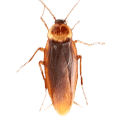
We also see American cockroaches (Periplaneta americana) — large, reddish-brown, 35-40 mm, slower breeders, drain-bound. American cockroaches in DH2 come up the bathroom drains from the cluster's stormwater manhole network. Different treatment — drain biocide application monthly, exterior bait stations at the cluster's stormwater inlets. AED 280-420 per visit. The American problem doesn't propagate cluster-to-cluster the same way the German problem does.
If you see both — and we see both in about 25% of DH2 jobs — you need both treatments. Combined first-visit AED 580-880.
Get the cluster booked
If you're in a Sahara, Akoya, Pacifica or any of the other DH2 phases dealing with cockroaches, book a survey and we'll inspect the cluster, not just your unit. You can also read more about residential pest control and our broader cockroach control approach.
FAQ
Can Damac Living force my neighbours to do pest control?
No. Damac Living operates community standards but pest control inside an owned unit is the owner's responsibility. They can issue notices about exterior hygiene but can't compel interior treatment.
What if my neighbour refuses to cooperate?
We'll still treat your unit, but we'll be honest about the reinfection risk. We can also do extra sealing work along the shared wall — expanding foam + intumescent strip behind your kickboard — which buys you 6-10 months of protection instead of 6-8 weeks. Adds AED 280-420 to the job.
Are DH2 cluster cockroaches resistant to common gel baits?
We haven't seen confirmed bait aversion or resistance in DH2 populations yet. The repeated treatment failures we see are propagation issues, not resistance. That said, we rotate active ingredients (hydramethylnon, indoxacarb, fipronil bait) annually as a precaution.
Does Damac's free annual pest control program cover this?
Free pest control programs offered as part of community management cover common-area treatment (street trees, communal drainage, public landscape) — not the interior of your villa. You'll see exterior fogging maybe quarterly. That doesn't address an interior kitchen problem at all.
Tags
Written by
Rashid Al Mansoori, Operations Manager
PestSwift technicians and entomologists publish field-tested pest control guidance for UAE homes and businesses.