

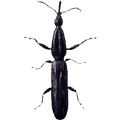
A Dubai Hills villa owner called us in March about a Khalas date palm whose central frond had collapsed sideways overnight. By the time we arrived the next morning, the spear leaf had come away in our hand. Inside the crown was a creamy mass of red palm weevil larvae, each the size of a thumbnail, working their way down through tissue that smelt of fermented dates. The tree was beyond saving. The two palms either side of it, however, were not — and that is where the work matters.
Red palm weevil — Rhynchophorus ferrugineus — is the most expensive insect pest in the UAE landscaping economy. MoCCAE has run national control programmes since the 1990s, ADAFSA reports treating hundreds of thousands of trees in Abu Dhabi each year, and Dubai Municipality maintains a complaint hotline for it. None of that helps the homeowner whose villa palm is already three months into an infestation.
The villa pest control angle on weevil is not the same as the date-farm angle. We are not protecting an industrial crop. We are protecting one to six palms that cost AED 8,000–25,000 each to buy and plant, and a lot more in landscape value. The protocol is preventive trunk injection plus pheromone monitoring, not aerial spraying.
Why the weevil is so hard to spot early
The female weevil cuts a small notch into a frond axil or a fresh wound and lays eggs. The eggs hatch in 2–5 days. The grubs eat their way down into the trunk core, where they spend 1–3 months becoming adults — and where you cannot see them. By the time the visible symptoms show on the outside, the trunk core is already partially hollowed.
The symptoms, in roughly the order they appear:
- Wet patches on the trunk with a fermented or vinegar smell. Often near old pruning wounds or the base of fronds.
- Frass and gnawed fibre at the base of fronds — fine red-brown sawdust that has been chewed and then exuded with sap.
- Drooping outer fronds. The first ones go horizontal-then-droop while inner fronds are still green and upright.
- Crown asymmetry. One side of the canopy starts to lean.
- Spear leaf collapse. The central upright frond falls or comes away with a gentle pull. By this point internal damage is severe.
- Crown drop. The whole canopy gives way. The tree is dead.
Most villa owners notice at stage 3 or 4. Stages 1 and 2 are visible from ground level but only if you look. We tell clients with three or more palms to spend ten minutes on a Friday morning every two weeks during summer with binoculars from the ground, scanning the frond bases.
What MoCCAE and Dubai Municipality do
MoCCAE coordinates the national programme: registers approved actives, sets the protocols, and runs the official pheromone trap grid on public land. Dubai Municipality's Public Parks and Horticulture team treats palms on public land and operates a reporting hotline for residents.
If you find weevil-infested palms in a Dubai villa, the standard path is:
- Report it via Dubai Municipality's complaints channel (the Dubai 800 hotline or the DM app). They log the GPS pin against their surveillance grid.
- Engage a licensed pest control company (one with MoCCAE biocide registration — see our explainer on PCO licence categories) for residential palm treatment. DM will not enter private plots.
- If the tree is dead, it must be cut down and the trunk material chipped to under 3cm pieces or incinerated — never left on site whole, because adult weevils continue to emerge from a felled trunk for weeks.
In practice, the homeowner pays for the treatment. DM does not currently subsidise private-property weevil work, although larger compound and master-community service providers often include it under common-area landscape contracts.
The trunk-injection protocol
For live but infested palms, and for at-risk healthy palms within 50m of a confirmed infestation, PestSwift uses a MoCCAE-registered systemic insecticide injected directly into the trunk via a sealed port. The actives we work with rotate between emamectin benzoate and imidacloprid formulations depending on tree size and current resistance bulletins.
The injection itself:
- A 9–12mm hole drilled into the trunk at the recommended height (usually 1.5m above ground).
- A sealed injection port screwed in, with a one-way valve.
- Active dosed at label rate (typically 2–4ml per metre of trunk height for a date palm).
- Port sealed with grafting wax to prevent re-entry by adult weevils.
The systemic moves through the trunk vasculature over 3–7 days. Any larva feeding on internal tissue dies. New eggs laid by foraging adults also fail because the larvae hatch into treated tissue. Protection lasts 4–6 months on date palms, with re-treatment every 6 months during high-risk season.
We do not recommend soil drench as a primary treatment for individual villa palms. Soil drench works for nursery stock and dense plantations but the active reaches the upper canopy slowly and unevenly in a 15m mature date palm, and it ties up a lot more active ingredient to deliver a smaller dose to where the weevil actually feeds.
Pheromone trap placement
Alongside injection, we install pheromone traps. The pheromone is Ferrolure (4-methyl-5-nonanol) plus a food-bait kairomone (dates, pineapple, molasses). Traps catch adult weevils flying in, give us a real-time count, and protect a 50–100m radius.
For a villa with 2–6 palms, one trap on the windward side of the plot is usually enough. For larger landscaped plots or compound clusters, one per 50m perimeter. We service the traps monthly: refresh the pheromone, refresh the food bait, count the catch.
A villa with a healthy trap count of zero for three consecutive months is in a low-risk pocket. A villa with eight trapped adults in one month is in an active flight corridor and needs preventive injection on every palm regardless of visible symptoms.
What it costs
For a Dubai villa with palms:
- Initial inspection and tree-by-tree risk assessment: AED 250–400, deducted from treatment if you proceed.
- Trunk injection per palm: AED 180–350 depending on trunk size and access.
- Pheromone trap installation: AED 400–600 per trap, including 12 months of monthly servicing.
- Annual programme for 4–6 villa palms with monitoring: AED 2,400–3,800.
A dead tree removal and chipping is separate — typically AED 1,200–2,800 depending on size and access for the boom truck.
Compare to replacement cost: a mature transplanted Khalas or Medjool date palm is AED 8,000–25,000 plus 18 months to look established again. Prevention is the obvious arithmetic.
What the villa owner can do
- Stop pruning during weevil flight season (roughly March–November). Fresh frond cuts release volatiles that attract females. If you must prune, immediately seal the cut with grafting wax and apply a label-dose contact insecticide to the cut surface.
- Avoid wounding the trunk with strimmer line, ladders pressed against the bark, or decorative lighting nails. Every wound is an entry point.
- Watch the irrigation. Over-watered palms produce softer tissue that the weevil prefers. Date palms in a Dubai villa need 80–120L per palm per week in summer, not more.
- Get neighbouring properties on board. If your neighbour has an untreated infested palm 20m from yours, your injection programme is fighting a losing inflow.
For visible signs of any palm-trunk pest, see our termite treatment per-area protocols — termite and weevil damage can look similar at a glance, but the treatments are very different.
FAQ
Can I save a palm whose spear leaf has already collapsed?
Honestly, usually not. Once the spear leaf is dead, the apical meristem (the growing point) is gone, and the tree cannot produce new fronds. We have saved a small number of palms caught right at spear-leaf droop, before full collapse, with an aggressive injection programme — but the success rate is low. The realistic call at that stage is to remove the tree and protect the others.
Are the chemicals safe for kids and pets in the villa?
The trunk injection is a sealed system. The active goes into the tree, not the soil or the air. There is no withholding period for kids playing nearby. Pheromone traps use insect-specific lures with no human or pet toxicity.
Does Dubai Municipality treat my villa palm for free?
No, not on private plots. DM treats palms on public land — roadside palms, parks, community landscaping in master-planned developments. Your villa garden is your responsibility.
How often should healthy palms be injected?
In a low-risk pocket with clean pheromone traps, once a year is enough. In an active corridor (Khawaneej, Mirdif, parts of Dubai Hills with mature plantings), every six months. The trap data tells us which one you are.
If your villa has date palms and you have never had them inspected for weevil, book a 20-minute ground-level inspection. We tell you which trees are at risk and which are already lost before we quote anything.
Tags
Written by
Dr. Karim El-Sayed, Lead Entomologist
PestSwift technicians and entomologists publish field-tested pest control guidance for UAE homes and businesses.