





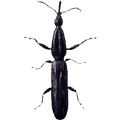
You opened the 5kg bag of basmati you bought last month and the surface is moving. Tiny dark beetles, a fine dust, maybe a few clumped grains webbed together. First reaction is always the same — "the shop sold me dirty rice" — and you bin the bag, scrub the shelf, and feel sorted. Three weeks later they're back, this time in the flour. Thing is, the rice probably wasn't the only thing carrying them, and a scrub-and-replace almost never ends it on its own.
Stored-grain bugs are the most under-diagnosed kitchen pest in the UAE, mostly because people don't realise the eggs come home inside the food.
Know what you're dealing with
Three different culprits get lumped together as "weevils" or "flour bugs". They behave differently.
- Rice weevil (Sitophilus oryzae). A small reddish-brown beetle, 2–3 mm, with a distinct long snout. The female drills into a single grain, lays an egg inside, and seals it — the larva eats the grain from the inside out, so you often don't see trouble until the adults chew their way out. This is the classic "bugs in my rice".
- Flour beetle (red or confused flour beetle, Tribolium). Tiny, flat, reddish-brown, no snout. Can't bore into whole grain, so it thrives in flour, semolina, milled products and broken grains. The one that turns up in your atta and maida.
- Indianmeal moth (Plodia interpunctella). Not a beetle at all — a small moth whose larvae spin the silky webbing you find clumping cereal, dates, nuts and dog food. Covered separately in our guide to pantry moths in UAE kitchens.
Telling weevil from beetle from moth matters because it tells you where else to look.
Why "I just bought it" doesn't mean it was clean
The hardest idea to accept is that the bugs were almost certainly already in the food when you bought it — as eggs, not adults. Grain gets infested in the field, the mill or the warehouse, and the eggs are microscopic and sealed inside grains or hidden in flour. The bag looks perfect on the shelf. Warm storage at home does the rest: in a UAE kitchen sitting at 28–32°C, eggs that might take months to develop in a cool climate hatch in weeks. That's why an infestation seems to appear from nowhere a few weeks after a shop.
It's also why this is worse here than in cooler countries. Heat speeds the whole life cycle. A 25kg sack of rice — and plenty of UAE households buy rice by the sack — sitting in a hot store cupboard or a garage is a slow-cooking incubator. By the time you notice, several generations have spread to anything else open nearby.
Clearing it properly
A scrub-and-replace fails because it misses two things: the cross-contaminated packets you didn't check, and the few beetles that have already walked into cracks in the shelving. Here's the method that actually ends it:
- Empty the whole cupboard, not just the obvious bag. Check every dry good — rice, flour, semolina, pulses, pasta, cereal, spices, dates, nuts, even pet food and birdseed. Weevils and flour beetles spread to all of it. Anything infested or open near the source goes out, sealed in a bag, into the outdoor bin (not the kitchen bin).
- Heat or freeze what you're keeping. For dry goods that look clean but you want to be sure of: freeze at -18°C for at least four days, or heat in the oven at 55–60°C for an hour. Both kill eggs and larvae. This is the step almost everyone skips, and it's the one that catches the hidden eggs.
- Vacuum, then clean the empty cupboard. Vacuum the shelves, corners, hinge gaps and the screw holes in the shelving — adults hide and lay in cracks. Then wipe down. A wipe of vinegar helps lift residue; it isn't an insecticide, so don't rely on it to kill anything.
- Re-store in airtight containers. Glass or thick rigid plastic with a proper seal — not the original paper or thin packaging, which beetles chew straight through. Airtight storage both contains any eggs you missed and stops new arrivals spreading. A couple of bay leaves in the container is a mild traditional deterrent; it's a nice-to-have, not a fix.
- Buy smaller, rotate stock. In this climate the sack-of-rice habit is a liability. Smaller quantities you'll use quickly, kept cool and sealed, beat a bulk bag slowly breeding in a warm cupboard.
When it's a job for us, not a clear-out
A single infested bag caught early is a DIY job — empty, freeze, seal, done. Call a professional when:
- it keeps coming back after two thorough clear-outs, which means there's a reservoir you haven't found — often spilled grain behind or under units, in a gap, or in a forgotten sack in the store;
- beetles are turning up away from the kitchen — in bedrooms, on walls, near windows — which means a hidden source is producing enough adults to disperse;
- it's a villa with a dry store, pantry or maid's-room cupboard where bulk dry goods are kept and the source is hard to isolate.
What we do that a clear-out can't: track the infestation to its reservoir, treat cracks and voids with a DM-approved residual that's safe for food-storage areas, and apply targeted measures (including pheromone monitoring traps for the moth species) so you can confirm it's actually gone rather than guessing. We keep chemical out of direct food contact entirely — the treatment is about the structure and the harbourage, not the food, which gets removed or heat-treated. This usually rides along with general villa pest control or apartment pest control since the same warm voids host other stored-product pests too; see our grain mites page for a related humidity-driven pantry problem.
FAQ
Is it safe to eat food with weevils in it?
It won't poison you — stored-grain beetles aren't toxic and people have unknowingly eaten the odd one in flour forever. But a visibly infested bag also carries eggs, larvae, droppings and mould risk, and it can trigger allergy in sensitive people, so the sensible move is to discard anything clearly infested rather than sieve and use it.
How do weevils get into sealed, brand-new packets?
Usually they don't break in — they were already inside as eggs laid in the grain or flour before packaging, at the field, mill or warehouse stage. The eggs are tiny and sealed within grains, invisible on the shelf, and they hatch once the food sits in your warm kitchen. That's why a sealed bag can "suddenly" have bugs.
Does freezing actually kill them?
Yes. Four or more days at -18°C kills eggs, larvae and adults of weevils, flour beetles and pantry moths. It's the most reliable home method for dry goods you want to keep, and a good habit for anything bought in bulk — freeze it for a few days before it goes in the cupboard.
Why does it keep coming back even after I throw everything out?
Because there's a reservoir you haven't removed: spilled grain in a gap behind or under the units, a forgotten sack in a store cupboard, or eggs in cracks in the shelving. If two careful clear-outs haven't ended it, the source is structural and worth having tracked down properly.
Can't shake stored-food bugs no matter how often you clear the cupboard? Get in touch and we'll find the reservoir. Explore villa pest control or read about a related pantry pest on our grain mites page.
Tags
Written by
Rashid Al Mansoori, Operations Manager
PestSwift technicians and entomologists publish field-tested pest control guidance for UAE homes and businesses.