
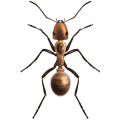


Four species, one villa, four treatment plans
A Khalifa City A villa we surveyed last September had ant trails in four different parts of the property — and four genuinely different species causing them. The kitchen had pharaoh ants budding off the dishwasher. The garden bed had fire ants. The driveway had pavement ants tunnelling through pavers. The wooden pergola had carpenter ants chewing through a softwood beam.
The owner had been spraying a generic ant killer from the supermarket on every trail he saw. The trails kept coming back, sometimes from the same spot, sometimes from a metre away. He thought he had "a lot of ants." What he actually had was four overlapping infestations, each with a queen he wasn't reaching.
This is more common in Khalifa City than people realise. The combination of villa gardens, irrigation drip lines, sandy soil, and pavement edges creates a perfect mixed-ant environment. And almost every species needs a different approach.
The four ants you'll meet in Khalifa City
Pharaoh ant (Monomorium pharaonis)
Tiny — about 2mm — light yellow to amber, almost translucent in good light. They love warm, humid indoor environments. In Khalifa City villas, you'll see them around the dishwasher, behind the kitchen splashback, in bathroom hinge channels, and around water heater plinths.
Why spraying makes them worse: pharaoh colonies bud. A spray separates a worker group from the main colony, and the workers raise a new queen from existing brood. Within a few weeks you've got two colonies instead of one. This is the single most important fact to know about pharaoh ants. Spray them and you breed them.
Pavement ant (Tetramorium caespitum)
Darker brown, about 3mm, with two small spines on the back. They nest under driveway pavers, in cracks of the boundary wall, along the irrigation trench edge. You see them streaming out of a paver gap in late afternoon, especially during the cooler months from October to March.
They do less damage than the others, but the colonies are huge — 5,000 to 10,000 workers under a single driveway is normal. They bite mildly when stepped on barefoot.
Fire ant (Solenopsis invicta or in some Abu Dhabi gardens Solenopsis geminata)
Reddish-brown, 3–6mm, build raised dome-shaped soil mounds in lawns and garden beds. The mound is the giveaway — fire ant nests look like small piles of disturbed earth, often after irrigation. They sting aggressively when the mound is disturbed, and the sting hurts for hours.
Khalifa City has a notable fire ant pressure because the soil + irrigation conditions favour them, and gardeners often inadvertently spread them by moving infested soil between plant beds.
Carpenter ant (Camponotus)
Largest of the four, 6–12mm, usually black or black-and-red. They don't eat wood — they tunnel through it for nesting. In Khalifa City villas, they're in the wooden pergola, the timber awning posts, and any softwood feature exposed to weather. You'll see fine sawdust (actually called "frass") under the wood.
They indicate moisture — carpenter ants colonise wood that's already been wetted. Repeated colonies in the same beam mean you've got a water leak or condensation issue you haven't found yet.
Why "just spray the perimeter" fails for all four
A single residual perimeter spray is the default for low-cost ant treatments in Abu Dhabi. It works — temporarily — for outdoor pavement and fire ants. It actively makes pharaoh ants worse. It doesn't reach carpenter ants inside wood. So one treatment leaves three problems unsolved.
Proper ant control on a Khalifa City villa is species-specific. Here's what each one needs:
- Pharaoh: gel bait (typically hydramethylnon, indoxacarb, or fipronil at very low dose), placed in 20–30 small dots inside void spaces near the trail. Workers carry it back. Colony collapses in 7–14 days. No spray ever.
- Pavement: granular bait (often containing borax or fipronil) broadcast along the trail edge, plus a perimeter spray of bifenthrin or deltamethrin against the wall base. Two-stage works; one-stage doesn't.
- Fire ant: mound treatment with a directly-injected liquid termiticide or fipronil drench, plus a broadcast bait (typically hydramethylnon granules) across the wider lawn. Don't try to dig out the mound — you'll get stung and the colony scatters into multiple new mounds.
- Carpenter ant: locate and treat the parent colony in the wood (drill, inject borate or fipronil), fix the moisture source that's keeping the wood damp, and spot-treat the foraging trail. Spraying the surface alone fails because the colony's deep inside the timber.
What ADPHC and the Ministry of Climate Change require
Abu Dhabi pest control sits under the Abu Dhabi Public Health Center (ADPHC), and the chemicals must be on the federal MoCCAE-registered list. For ants in residential settings, the practical implications are:
- The technician must be ADPHC-certified, with a current ID card you can ask to see.
- Every gel and granular bait used must have a registration number traceable to the MoCCAE database.
- The treatment certificate must list active ingredient, dose, location of application, and a re-entry interval (usually 0 hours for gel, 4 hours for residual sprays).
- For fire ant work in shared community gardens (e.g. Khalifa City A common areas), the community manager must be notified before treatment.
We cover the parallel Dubai-side regulation in our piece on Dubai Municipality approved pesticides. The Abu Dhabi process is broadly similar but the registration body is different.
Real cost bands for a Khalifa City villa
For a 4-BR villa with a typical garden of 200–300 m²:
- Single-species treatment, indoor only (e.g. just pharaoh): AED 280–420
- Single-species treatment, outdoor only (e.g. just pavement at driveway): AED 350–550
- Mixed-species villa-wide treatment with garden, two visits 14 days apart: AED 850–1,400
- Fire ant focused garden treatment, broadcast bait + mound injection: AED 600–950
- Annual pest management contract covering ants + other crawling pests, quarterly visits: AED 2,400–3,800/year
Most Khalifa City villa owners benefit more from the contract option than the one-off — the irrigation cycle and soil conditions mean ant pressure rebuilds within 4–6 months even after a perfect treatment.
What you can do in the meantime
- Identify the species before treating. Take a clear close-up photo and send it to us — we'll ID it within the day at no cost.
- Don't squash trails. The crushed-ant alarm pheromone signals other workers and you'll see more ants, not fewer.
- Don't move soil between garden beds without checking for fire ant brood — that's how new mounds appear.
- Pull mulch and decorative wood chips back from villa walls and pergola posts. Carpenter ants love the moisture pocket those create.
- Fix any irrigation drip line that's pooling water against the foundation. Standing water near the wall is a pavement-ant invitation.
For parallel cluster patterns in other emirates, ant behaviour in Al Reem Island towers covers the high-rise side, and ant control in Al Nuaimiya, Ajman covers mid-rise apartments. The Khalifa City area page shows our full coverage there. To book a free species-ID inspection, contact us.
Frequently asked questions
How can I tell pharaoh ants apart from regular small ants?
Three clues. Size (pharaohs are 2mm; most other small ants are 3mm+). Colour (pharaohs are pale yellow-amber, almost translucent; other small ants tend to be brown or black). Trail behaviour (pharaohs split into multiple mini-trails when disturbed because they bud; most other species hold a single coherent trail). If you're unsure, send us a close-up.
Are fire ant stings actually dangerous?
For most adults, painful but not medically serious. The sting forms a small white pustule within 24 hours that usually heals over a week. For young children, anyone with a known insect-sting allergy, and anyone who gets stung 20+ times at once (which happens if you stand on a mound), it can be serious. Anaphylaxis is rare but documented. Keep adrenaline auto-injectors accessible if anyone in the household has a history.
Can carpenter ants damage my villa structurally?
Not quickly. Carpenter ants tunnel through wood for nesting, not food, so they're slower than termites. A mature colony in a pergola beam can compromise it over 2–3 years. The bigger structural concern is what they're telling you about — repeated carpenter-ant colonisation means you have moisture infiltration somewhere that's softening the timber.
How long does an ant treatment last?
Depends on species and conditions. A proper pharaoh gel-bait treatment indoors typically holds 6–12 months. Fire ant garden work holds 3–6 months because reinvasion from neighbouring lawns is common. Pavement ant work holds 4–8 months. Carpenter ant treatments are essentially permanent for that colony, but you'll get new colonies if the moisture issue isn't fixed.
Tags
Written by
Dr. Karim El-Sayed, Lead Entomologist
PestSwift technicians and entomologists publish field-tested pest control guidance for UAE homes and businesses.