



They come from between the interlock blocks
Here's what we hear two or three times a week from Town Square owners: the kitchen is clean, the pantry is sealed, the bins are managed — and there's still a thin black trail running from the back door across the tiled lobby toward the fruit bowl every morning at 6 AM.
The kitchen isn't the problem. The driveway is. Or more precisely, the bedding sand directly beneath your interlock paver driveway, which is where the colony actually lives. The trail you see indoors is the foraging file, returning to a nest you've been parking on.
This is the Town Square Nshama ant pattern. It's not unique to the development, but the combination of interlock paving over loose bedding sand, daily landscape irrigation, and warm but not extreme spring temperatures lines up the conditions almost perfectly from late February through early June and again from October.
Pavement ants are the usual culprit
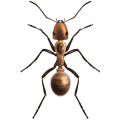
The species we identify most often on Nshama villa jobs is Tetramorium caespitum — the pavement ant. Small (2.5–4 mm), dark brown to nearly black, mildly hairy on the abdomen. Workers form clear trails along edges. Colonies are 3,000–10,000 strong with multiple queens.
They are called pavement ants for a reason. In every habitat they occupy, the colony cavity is under a paved surface or a stone — sidewalks, patios, driveway pavers. In Town Square the bedding sand layer under your interlock blocks is a perfect colony footprint: stable temperature, protected from rain, easy access to soil moisture from the irrigation underneath, and a vast roof.
The other species we see in Nshama villas in much smaller numbers:
- Monomorium pharaonis (pharaoh ant) — tiny, amber, indoor-only. Different problem, different treatment. We have a pharaoh ants Dubai apartment post specifically about these.
- Camponotus species (carpenter ants) — large, occasional, do not nest in pavers but in wood. Rare in Town Square's mostly concrete-frame villas.
- Paratrechina longicornis (crazy ant) — long-legged, erratic trail. Occasional in newer phases.
95% of the calls are pavement ant. The protocol below is for that species.
Why irrigation makes it worse
Nshama villas were handed over with default landscaping plus drip irrigation on a fixed schedule. Daily, often in the cool morning. The drip runs along the foundation strip and the planter beds adjacent to the driveway.
Water moves laterally through bedding sand. The driveway sand layer gets a daily moisture top-up. Pavement ants need moisture for brood development. The colony grows in proportion to how reliable the moisture supply is.
This is the root cause. We can treat aggressively, but if the irrigation schedule stays the same, you'll see the trails return in 90–120 days. The lasting fix has two parts: kill the current colony, and reduce the moisture corridor.
The treatment protocol
Step 1: Identify the trail back to the entry point
We walk the foundation perimeter and the driveway edge with the trail. Pavement ant trails are surprisingly persistent — workers lay a pheromone trail that other workers follow back. Within 10 minutes we can usually find where the trail emerges from the paver joint.
That emergence point is over the colony. Mark it.
Step 2: Perimeter chemical band — Fipronil
A Fipronil 0.05% suspension concentrate applied as a 30-cm band along the foundation and a 15-cm band along the driveway edge at the building line. Sprayed under low pressure to penetrate the joint between blocks without forcing chemical down to depth.
Fipronil has a key property for ant control: slow-acting transfer. A forager touches it, returns to the colony, contacts brood and queens during grooming, and transfers the active ingredient through the colony before the forager itself dies. Field studies on pavement ant treated with Fipronil show colony collapse over 14–28 days post-application. One application — done correctly — eliminates the colony.
The risk if applied wrong: too high pressure, and you force the chemical down to depth quickly enough that the foragers die before they return to the colony. We see this in DIY supermarket Fipronil applications where homeowners spray the joint directly with a pressurised can. The trail dies in a day, the colony survives, and the problem comes back in 3 weeks.
Step 3: Indoor gel-bait — Indoxacarb
For the trail that's already reaching your kitchen, we place Indoxacarb 0.6% gel-bait at trail intercepts. This is the bait pavement ants prefer when foraging indoors — sugar-based formulation that matches their indoor food source.
Bait placements are small (pea-sized), maybe 6–10 in a typical Nshama villa. Behind the kick-plate on the kitchen island. Inside the under-sink cabinet. Along the trail line on tile grout near the door threshold. Out of reach of children and pets but accessible to ant foragers.
Indoxacarb in gel-bait is a slower-acting trans-active ingredient than Fipronil and adds a second elimination path through the colony. Combination of perimeter Fipronil + interior Indoxacarb gel gives reliable 95%+ colony elimination by day 21.
Step 4: Irrigation adjustment recommendation
We write to the gardener (or the owner if there's no contracted landscaper) recommending:
- Move the drip line at least 30 cm away from the foundation and the driveway edge
- Reduce daily run to alternating days during cooler months (December–February)
- Avoid surface flooding from sprinkler over-spray
- Mulch the planter strip nearest the driveway with 5 cm of decorative gravel rather than wood mulch — gravel doesn't retain ant-attractive moisture
This is the recurrence-prevention piece. Without it, you'll be calling us again in spring.
What it costs in Town Square
Real Nshama villa pricing for ant treatment:
| Scope | Price |
|---|---|
| Standard 3–4 BR villa, single ant trail | AED 350–450 |
| Heavy infestation, multiple trails, multiple colonies | AED 500–700 |
| Annual prevention package — quarterly perimeter band + landscape walk | AED 1,400–1,800 |
The annual prevention package is what most Nshama owners adopt after the first treatment. It's roughly the cost of two ad-hoc treatments per year, and it prevents the reactive cycle.
For more on annual contract economics across UAE, see annual pest control contract cost UAE.
Why over-the-counter products usually fail
Let's be honest about this. The pest-control aisle at Carrefour has ant sprays, ant traps, and a couple of Fipronil products. They aren't always wrong. They are often misused.
Common failure modes:
- Spraying directly down the joint. As above, kills foragers fast, colony survives.
- Wiping the trail clean before laying bait. Removes pheromone — ants stop coming to the bait station.
- Mixing repellent insecticides with bait. Repellents repel ants; bait needs them to feed. Use one or the other, never both at the same site.
- Using bait that's stale. Most supermarket gel-baits are 18–24 months past manufacture. Pavement ants reject stale bait.
The contractor cost difference (DIY AED 80 vs professional AED 400) reflects the protocol difference. Pick the route that solves the problem, not the line item.
What you can do this week
Before the technician arrives:
- Do not wipe the visible ant trails — we need to track them.
- Do not spray household insecticide along the path — it makes the foragers scatter and complicates bait placement.
- Do clear access to the driveway edge and foundation perimeter — move pots, decorative gravel piles, or stored items at the wall.
- Do make a quick map of where you've seen trails (back door, kitchen, terrace) — saves us 15 minutes of survey time.
FAQ
How long before the trails stop?
Visible trail traffic drops sharply in 3–5 days as foragers carry bait back. Full colony collapse takes 14–28 days for pavement ant. Don't be surprised by a brief uptick in trail activity in days 1–2 as foragers actively recruit to the bait — that's the protocol working.
Will the perimeter spray stain the driveway?
No. The Fipronil suspension at the dilution we apply is colourless and dries within 30 minutes. It doesn't etch concrete, paver block, or natural-stone borders. Avoid heavy hosing of the perimeter strip for 5 days after treatment to preserve the active band.
Is this safe for kids and pets?
Fipronil at perimeter-band dilution is bound to the substrate within 30 minutes of application; surface residue available to mammals is minimal. The Indoxacarb gel-bait inside is placed out of reach with bittering agents that deter mammalian uptake. We mark every interior bait placement on a homeowner card so you know where each one is.
What if I have multiple ant species?
We identify before we treat. Pharaoh ants and pavement ants require completely different bait formulations — pharaoh ants will reject the Indoxacarb gel that pavement ants prefer. If your trails are tiny amber ants moving inside the kitchen (not from outside), call out the species when you book — it changes our toolkit.
Get the trail mapped, the colony eliminated
If you're heading into the warm months and the ant trails are already running across your Town Square villa floor, the next 4 weeks are the best treatment window of the year. We can audit the foundation and driveway, map the colony entry, treat in one visit and follow up at day 21. Get a Town Square Nshama villa quote, or read the full ant control service overview.
Tags
Written by
Dr. Karim El-Sayed, Lead Entomologist
PestSwift technicians and entomologists publish field-tested pest control guidance for UAE homes and businesses.