





A tenant in an older block off Hamdan Street called us last summer after three separate companies had "treated" her flat. Each one sprayed the kitchen, charged AED 150, and left. Each time the roaches were gone for ten days and back by the third week. When our technician opened the kickboard under her sink, the reason was obvious: a live German cockroach population running along the shared drainage stack that served the whole riser of flats above and below her. Spraying her kitchen was never going to win that fight.
This is the central Abu Dhabi cockroach story, and if you live in one of the older Hamdan, Madinat Zayed or Al Khalidiya buildings, it's probably your story too.
Why the older blocks are different
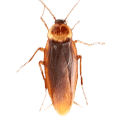
The towers along and behind Hamdan Street are some of the city's earliest high-density residential stock. Decades of use mean shared service risers, common refuse chutes, interconnected drainage, and the small gaps that open up around pipework as a building settles. For a German cockroach, Blattella germanica, that's a superhighway.
German roaches don't roam in the open by choice. They live tight against warm surfaces in the dark, behind the fridge motor, inside the dishwasher housing, in the hinge channels of cabinets, under the sink, around the water heater. They travel between flats through the very channels that connect the building: the chiller and plumbing chases, the chute, the gaps where conduits pass through walls. One heavily infested flat seeds the units around it.
That's the mechanism that makes single-flat spraying fail. You can kill every roach inside your four walls and still get recolonised within days from the neighbour you've never met.
Why spraying makes it worse, not better
Surface spray, the cheap default in this market, has two problems with German cockroaches.
First, coverage. The spray hits exposed surfaces, but the population lives in voids the spray never reaches. You knock down the few foragers you can see and leave the breeding core intact.
Second, behaviour. Pyrethroid sprays repel roaches. Hit a harbourage with a repellent and you don't kill the colony, you scatter it, pushing roaches deeper into wall voids and into adjacent flats. Plenty of "the roaches got worse after they sprayed" complaints trace back to exactly this.
The method that works is gel bait, placed precisely. Workers feed on it, return to the harborage, and die there, and the rest of the colony feeds on the carcasses and droppings, carrying the active ingredient through the population, including the nymphs and the egg-bearing females you'd never reach with a spray. One careful gel treatment beats three sprays, every time.
What proper treatment of a Hamdan Street flat involves
Here's how we approach a central-AD apartment job.
Inspection first. We pull the kickboards, check behind and under the fridge and dishwasher, open the sink cabinet, inspect the water-heater cupboard, and look at where pipes and conduits enter the kitchen and bathroom. We're locating harbourage and, just as important, the inter-flat entry points.
Gel bait in the voids. ADPHC-registered gel goes into the motor cavities, hinge channels, cabinet corners and pipe entries, dosed as small placements where the roaches actually travel. We avoid spraying over bait, because the repellent stops them feeding.
Seal the highways. We seal or stuff the gaps around pipework and conduit penetrations with the right materials, so even as we knock down your population, recolonisation from the riser slows down. This is the step that turns a temporary win into a lasting one.
Insect growth regulator where needed. For an entrenched infestation, an IGR stops nymphs maturing and breaks the breeding cycle alongside the bait.
Follow-up. German cockroach jobs almost always need a second visit at two to three weeks to hit the nymphs that hatched from egg cases after the first treatment. Any company that promises one-and-done on an established infestation is overselling.
Typical pricing for this work in a central Abu Dhabi 1 to 2-bedroom flat runs about AED 200 to 400 for an initial treatment plus follow-up, more if the infestation is severe or the kitchen is large. That's more than the AED 150 spray, and it's the difference between solving the problem and renting a two-week pause.
The bit you can't fix alone: the building
If your flat keeps getting reinfested no matter how well it's treated, the source is elsewhere in the building, and that needs a building-level response. A few moves help:
- Talk to neighbours on your riser, especially directly above and below; coordinated treatment of a stack is far more effective than one flat.
- Raise it with the building management or owners association. Common-area pest control, the chute, basement, risers and drainage, is the building's responsibility, and we cover who pays for what in our guide to pest control responsibility in shared buildings.
- For labour-style or densely shared units, the dynamics are slightly different again, see our piece on cockroach control in Mussafah shared accommodation.
A whole-building apartment programme that treats the common services and the units together is the only thing that truly clears a riser. It costs more upfront and it's the only approach that stops the merry-go-round.
Keep them from coming back
Once we've cleared a flat, staying clear is mostly about denying food, water and entry:
- Fix dripping taps and the under-sink seal; German roaches can live on water alone for longer than they can on food.
- Don't leave dishes wet overnight, wipe the dishwasher seal, empty the kitchen bin nightly.
- Keep dry goods in sealed containers.
- Re-check and re-seal pipe penetrations annually; buildings keep moving.
FAQ
Why do the cockroaches come back two weeks after every spray? Because spray hits the surfaces but not the voids where the colony breeds, and in a connected older building, survivors plus migrants from neighbouring flats repopulate fast. The egg cases are also spray-resistant; they hatch after the spray has dried. Gel baiting the harbourage and sealing inter-flat gaps is what actually stops the cycle.
How much should cockroach treatment cost in an Abu Dhabi apartment? A proper gel-and-IGR treatment with a follow-up visit for a 1 to 2-bedroom flat is roughly AED 200 to 400. A AED 150 single spray is cheaper because it does less, you're usually paying again within the month. Ask what method is used and whether a follow-up is included before you compare prices.
Is the pest control company I hire supposed to be ADPHC-registered? In Abu Dhabi, yes, pest control operators and the products they use fall under Abu Dhabi Public Health Center oversight. Using a registered operator means the chemicals are approved and applied by trained, carded technicians. It's a fair question to ask before anyone treats your home.
Can I just treat my own flat, or does the whole building need doing? If your infestation is contained and your neighbours are clear, treating your flat properly can hold. If you keep getting reinfested, the building is the reservoir and you'll need coordinated or common-area treatment to win. The reinfestation pattern is the tell.
Stuck in the spray-and-return cycle in a Hamdan Street block? Book a proper inspection and we'll find the harbourage and the inter-flat highways, then treat for the colony instead of the few roaches you can see.
Tags
Written by
Rashid Al Mansoori, Operations Manager
PestSwift technicians and entomologists publish field-tested pest control guidance for UAE homes and businesses.