




Bluewaters Island has 698 apartments and one consistent complaint that property managers don't put on the brochure: from May through October, after about 6:30 pm, the sundown breeze from the open sea side carries mosquitoes inland across the boulevard. Residents on the lower five floors of the Ain Dubai-facing towers get hit hardest. The cafés along the boardwalk lose around 20% of evening covers to people relocating indoors.
The mosquitoes aren't drifting in from the mainland. They're breeding on the island.
Why Bluewaters has its own mosquito microhabitat
The island's geometry creates conditions Aedes and Culex both exploit, in different ways.
The podium-level landscaping between the residential towers and the boardwalk has irrigation drip lines feeding raised planters. The drip line emitters drip onto soil, but the catch trays underneath the decorative planters hold water for days at a time. That's the Aedes aegypti incubator — the day-biting yellow-fever mosquito that vectors dengue.
The marina drainage channels along the western edge fill with seawater spray and freshwater rinse from the boardwalk hose-down. The brackish mix is exactly what Culex sitiens prefers. Culex are the dusk-to-dawn biters you notice on your balcony at 8 pm.
The AC condensate management on the residential blocks dumps to a shared roof tray that drains slowly during humid weeks. We've inspected three towers where the tray held 4 to 6 cm of standing water for over a week — enough for a full Culex generation cycle.
The planter wells around Ain Dubai's structural base retain water from the daily wash-down. Meraas does maintain these, but the cycle isn't tight enough to break the 7-day Aedes egg-to-adult window in summer heat.
Net result: the island grows its own mosquito population. Treating individual apartments without addressing the source containers is whack-a-mole.
Aedes vs Culex: why the time of day matters
Two species, two bite patterns, two protocols.
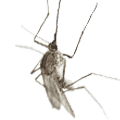
Aedes aegypti is daytime active, peaks at dawn and dusk, and is the species under formal Dubai Health Authority surveillance because of dengue. They're small, dark with white markings on the legs, and they don't make the high-pitched whine you remember from your childhood. They land silently. They prefer to bite ankles and the back of the neck. Aedes lay eggs above the waterline in small containers — the egg can survive dry for months and hatch the moment water returns.
Culex sitiens (and the related Culex pipiens) is the dusk-to-dawn biter. Larger, brown, the classic mosquito profile and whine. They lay egg rafts directly on the water surface. They breed in larger water volumes — the AC tray, the marina drainage channel, the manhole catchments.
On Bluewaters in May through July, you'll get both species in the same evening. The 6:30 pm boulevard hit is mostly Aedes finishing their dusk activity. The 8 pm balcony bite is Culex starting their night shift.
What we do for Meraas-managed common areas
Bluewaters is a single-management estate. Meraas controls the boardwalk, the podium, the marina, and the common AC plant rooms. Apartment owners control their balconies and their interiors.
For common areas, the protocol that works:
- Bti briquette dosing in every standing-water container we can identify, on a 28-day cycle. Bti (Bacillus thuringiensis israelensis) is a biological larvicide — it kills mosquito larvae specifically and is safe for fish, birds, pets and humans. The boardwalk drainage channels and the Ain Dubai planter wells are the priority sites.
- AC condensate tray clearance on a 14-day cycle during the May to October peak, dropping to 60-day in winter.
- Marina-edge ULV (ultra-low-volume) fogging with deltamethrin at sundown on the worst weeks — usually three to four targeted sessions per summer, scheduled around restaurant booking patterns to minimise customer disruption.
- Surveillance trap deployment (BG-Sentinel for Aedes, gravid traps for Culex) at six fixed points, monitored weekly during peak. Trap counts trigger the ULV fogging schedule.
What apartment owners can do on their balconies
Three actions clear most personal-balcony mosquito issues:
- Empty plant saucers weekly. The decorative pots on a Bluewaters balcony catch enough water in 48 hours to host a full Aedes brood. Tip out, wipe dry, refill if needed.
- Dose the AC condensate drip with a Bti tablet. AED 25 per tablet, lasts 30 days. Drop one into the drip-tray every month from April through October.
- Fit a fine-mesh balcony screen on a removable frame if you sit out at sundown. A 0.6 mm mesh blocks Aedes; a 1 mm mesh blocks Culex but not the smallest Aedes individuals. Mesh is reversible and Meraas community rules permit removable frames.
For balcony-specific treatment, we offer a one-off larvicide and surface treatment for AED 320 per 1-2BR balcony, AED 480 for 3BR-plus. Includes the Bti dosing and a perimeter spray of a residual pyrethroid (deltamethrin SC, Dubai Municipality-approved) on the balcony walls and ceiling — the residue keeps mosquitoes from resting in shaded balcony corners during the day.
When dengue surveillance matters
Dubai Health Authority runs a passive dengue surveillance programme — when a confirmed case is reported in a residential community, the area receives intensified municipal larviciding plus a vector survey within 5 working days. Bluewaters has been included in the August 2025 sweep based on Aedes index readings, which is good news (means surveillance is working) and a useful prompt for residents to do their own balcony check.
If you've travelled to Sri Lanka, Indonesia, the Philippines, or any active dengue zone in the past month and develop fever within 14 days of return, see a doctor and mention the travel history. The Aedes population on Bluewaters is the local vector.
Why fogging alone is the wrong answer
Some property managers and individual residents push for evening fogging as the visible "we're doing something" response. Fogging knocks down adults — that's it. It doesn't touch larvae, doesn't break the breeding cycle, and the adult population recovers within 7 to 10 days. Used in isolation, fogging is theatre.
Fogging is useful as a tactical knockdown when adult biting pressure is genuinely high — a wedding event, a major restaurant night — alongside the source-removal work. It's not a substitute for the larvicide programme.
What a typical summer-long contract looks like for a Bluewaters tower
A 100-apartment Bluewaters block on a full-season common-area contract from May through October typically pays AED 18,000 to 24,000 for the six-month period. That covers monthly Bti dosing of all common containers, fortnightly AC tray clearance, weekly trap monitoring, three to four targeted ULV sessions, and a written end-of-summer report for the OA.
Per-apartment that works out to roughly AED 30 to 40 per month — less than the cost of one repellent candle replacement.
For comparison, see our annual pest control AMC coverage breakdown and the AC drain mosquito breeding deep-dive which goes into the chiller-tray issue in more detail.
FAQ
Why don't I see mosquitoes during the day on Bluewaters?
You probably do — Aedes aegypti is daytime-active but bites silently and is only 4 mm long. Most people register the bite as an itch in the evening without seeing the mosquito at the moment of biting. Watch your ankles around mid-morning and again at sundown; that's when Aedes is most active.
Is dengue actually a risk on Bluewaters Island?
The island is in a low-but-not-zero risk zone. Aedes is present and breeding, but locally-acquired dengue cases in Dubai remain rare. The bigger risk is travellers returning from active dengue countries who get bitten by a local Aedes during their viraemic period. Maintaining low Aedes population density on the island — through the source-removal work — is the single best protection.
Can I just install a Mosquito Magnet trap on my balcony?
CO2-baited traps work for Culex and to a lesser extent for Aedes, but they only protect the immediate area around the trap (roughly 10 metres). On a Bluewaters balcony with sea breeze blowing past, the protective zone is shrunk further. Useful as a supplement, not a replacement for source-removal in the common areas.
How quickly can you respond to an unexpected mosquito surge?
For Bluewaters specifically, we keep a same-week service slot through summer because the demand pattern is predictable. A balcony or apartment treatment can usually start within 2 to 4 working days. Common-area emergency fogging needs 24 to 48 hours notice to coordinate with Meraas estate management.
Want to pre-empt the August Aedes peak? Book a Bluewaters source-removal walk-through. One technician, 90 minutes, you'll know exactly which containers on your balcony and your floor's common area need treating before the bites start.
Tags
Written by
Dr. Karim El-Sayed, Lead Entomologist
PestSwift technicians and entomologists publish field-tested pest control guidance for UAE homes and businesses.