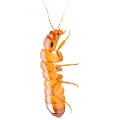
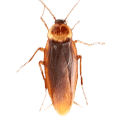

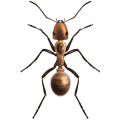



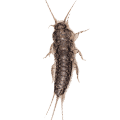

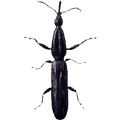
Two roaches, same kitchen, completely different problems. The little tan one scuttling along the back of your counter at night and the big reddish one that lumbered out of the bathroom drain are not the same species — and treating them as if they are is the single most common reason a cockroach job fails in the UAE.
Identification isn't a biology lesson for its own sake. The species tells you where the insects are breeding, how the population behaves, and which treatment will actually work. So before you spend money on spray, learn to read what's in front of you.
The three you'll meet in a UAE home
Of the dozens of cockroach species worldwide, three account for nearly everything we find in Dubai, Sharjah, Abu Dhabi and Ajman homes.
German cockroach — the indoor breeder
This is the important one. The German cockroach (Blattella germanica) is small — around 13 to 16 mm, roughly a centimetre and a half — and light tan to brown, with two dark parallel stripes running down the shield behind its head. Adults have wings but rarely fly.
It lives indoors, full stop. You'll find it in the kitchen and bathroom, packed into warm, tight harborage: behind and under the fridge, inside the dishwasher motor cavity, in cabinet hinge channels, under the sink lip, behind the kickboard. It breeds astonishingly fast — a single female and her offspring can produce tens of thousands of individuals in a year — which is why an unchecked German infestation explodes.
If you see small tan roaches, or roaches active in daylight (a sign of overcrowding), this is almost certainly your species. It's also the one that spreads between flats through shared plumbing risers in apartment buildings.
American cockroach — the drain and drain migrant
The "big one." The American cockroach (Periplaneta americana) is 35 to 50 mm — an inch and a half to two inches — and reddish-brown with a pale yellowish edge around the shield. It can glide short distances, which is why people swear they "flew" at them.
Despite the name, it's an outdoor and sub-structure insect. It lives in drains, sewers, manholes, basements, garbage rooms and AC ducts, and comes up into homes through floor drains, the chute and gaps around pipework — especially in summer when conditions outside get extreme. It doesn't usually breed inside your kitchen cabinets. So the fix isn't cabinet gel; it's drain treatment, trapping and sealing the entry points.
Oriental cockroach — the damp specialist
Less common but worth knowing. The Oriental cockroach (Blatta orientalis) is dark, almost black, glossy, 20 to 30 mm, and looks heavy-bodied. It loves cool, damp, low places: sump rooms, basement plant rooms, under floor slabs, around leaking pipework. In homes it turns up in service areas and ground-floor utility spaces rather than upstairs kitchens. It's slower-moving and gives off a notably musty smell.
A quick field key
If you only remember one thing, remember this:
- Small, tan, two stripes, in the kitchen → German. Breeding indoors. Needs gel-bait in voids.
- Large, reddish-brown, from the drain or bathroom → American. Coming from outside/below. Needs drain treatment and sealing.
- Dark, glossy, heavy, in a damp basement or utility area → Oriental. Moisture problem. Fix the damp, then treat.
Size and colour get you 90% of the way. Add where you saw it and you're essentially there.
Why misidentifying costs you money
Here's the practical payoff. Each species needs a different control strategy, and using the wrong one wastes both money and time.
Treat a German infestation with aerosol fogging and you'll scatter the colony deeper into the voids — the survivors breed back within weeks, and you've made the harborage harder to reach. German roaches need gel-bait placed in the voids, plus an insect growth regulator so nymphs can't mature. That's it. No fogging.
Treat an American problem with kitchen cabinet gel and you'll achieve nothing, because they're not living in your cabinets — they're coming up the drain. The fix is treating the drains and chute, fitting drain covers, and sealing the gaps around pipes.
Treat an Oriental infestation without fixing the underlying moisture and they'll keep returning no matter how much product you apply.
This is exactly why we identify before we treat. It's also why we lean on gel and targeted methods rather than blanket spraying — the approach has to match the biology. For the German cockroach specifically, the harborage-led method is the same one we describe for German cockroaches in JLT kitchens.
What makes UAE homes a cockroach paradise
A few local factors amplify all three. Air conditioning keeps interiors at a steady, warm humidity year-round, so there's no winter die-back to reset the population. The hottest months drive American cockroaches indoors from drains and sewers seeking cooler, moist refuge — a seasonal surge we see every summer. And dense apartment living gives German cockroaches shared risers to travel through. Identification tells you which of these dynamics you're up against. If you're seeing the summer spike, our note on the summer cockroach surge covers the timing.
When to call a professional
A couple of stragglers from the drain that you can seal out? You may not need anyone. But if you're seeing small tan roaches in the kitchen, or any roaches in daylight, treat it as an established German infestation and act fast — the population only grows. A professional inspection identifies the species, finds the harborage, and applies the matched treatment with a warranty.
Reading the evidence, not just the insect
You won't always catch a roach in the open, so identification often comes down to the traces they leave — and those traces point to the species too.
German cockroaches leave droppings that look like finely ground black pepper, concentrated around hinges, in drawer runners and along the top inside edge of wall cabinets. Heavy infestations carry a faint oily, musty smell from the aggregation pheromone. Their egg cases (oothecae) are small, brown and often carried by the female until close to hatching, so you find them wedged in tight corners.
American cockroaches leave larger droppings with blunt ends, often near drains, in basements or around the chute — and they drop their egg cases rather than carry them, so you may spot dark, capsule-shaped cases glued near a drain or pipe.
If the droppings are pepper-fine and in the kitchen, think German and act quickly. If they're larger and near a drain, think American and look to your drainage and seals.
FAQ
What is the difference between German and American cockroaches? Size, colour and behaviour. German cockroaches are small (about 1.5 cm), tan with two dark stripes, breed indoors in kitchens and bathrooms, and multiply explosively. American cockroaches are large (up to 5 cm), reddish-brown, and live in drains, sewers and basements, coming up into homes from below. They need completely different treatments.
Which cockroach is in my UAE kitchen? If it's small and tan and active at night on your counters or in cabinets, it's almost certainly a German cockroach breeding indoors. If it's large and reddish and appeared near a drain or bathroom, it's an American cockroach that came up from the drainage.
Why are there big flying cockroaches in Dubai bathrooms? Those are American cockroaches. They can glide short distances and they enter through floor drains and gaps around pipework, especially in summer when they move indoors from the sewer system seeking moisture and cooler conditions. Drain covers and sealing keep them out.
Do I need different treatments for different cockroaches? Yes — that's the whole point of identifying them. German cockroaches need gel-bait in voids plus an IGR. American cockroaches need drain treatment and sealing. Oriental cockroaches need the moisture source fixed first. Using one method for all three is why DIY attempts usually fail.
Not sure what you're dealing with? Send us a photo or book an inspection and we'll identify the species and match the treatment. More on cockroach biology and control and our apartment pest control service.
Tags
Written by
Dr. Karim El-Sayed, Lead Entomologist
PestSwift technicians and entomologists publish field-tested pest control guidance for UAE homes and businesses.